
Why patients travel here
Ketamine infusions are offered in clinics across the country. Four things separate what happens here.
If there is a good program near you, use it. These are the reasons people fly to Sarasota instead.
01
Ketamine is an anesthetic, and an anesthesiologist gives it
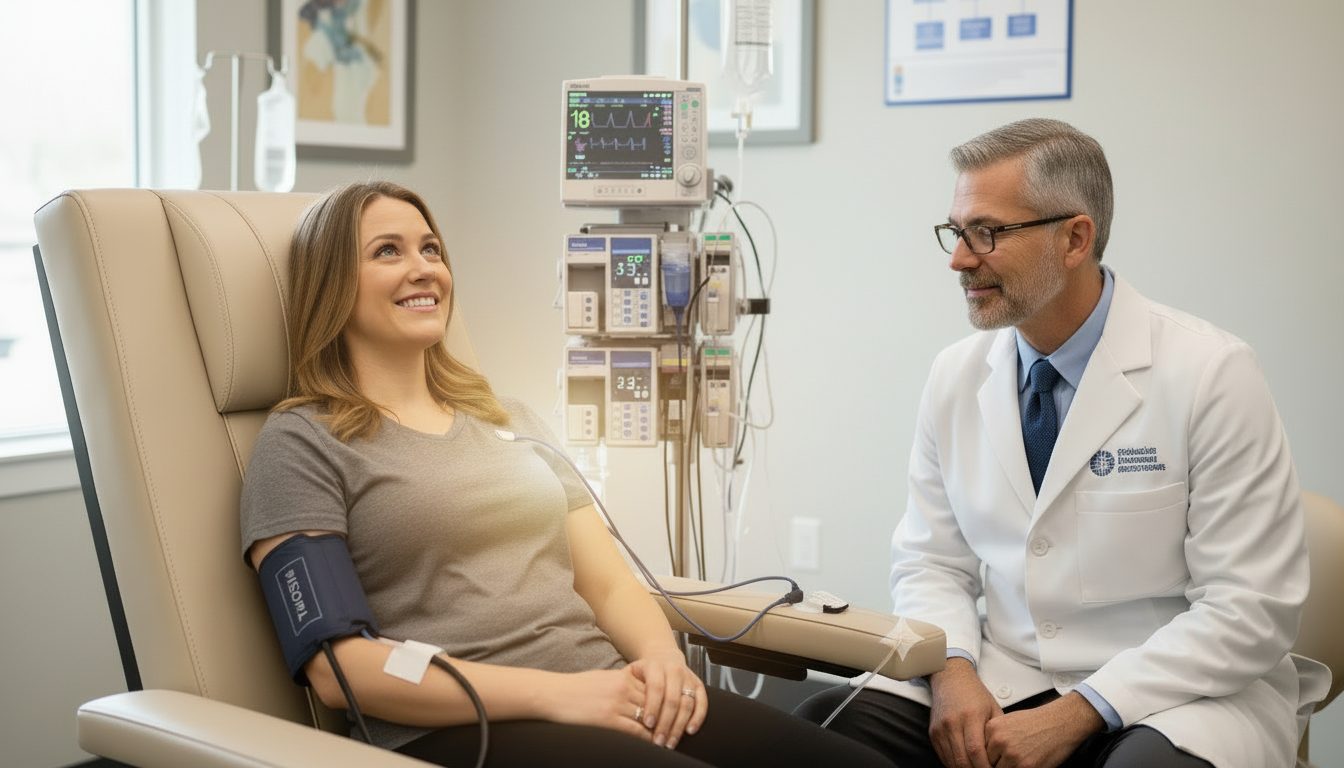
Ketamine has been an anesthetic since 1970 [7], and anesthesiology is the specialty built around it — managing breathing, sedation, blood pressure and heart rhythm while someone is under, and recognizing early when any of them is drifting. The physician who treats you here spent his career doing that. It is the training that matters least when an infusion goes exactly as planned, and most when it does not.
02
Your dose is set by your body chemistry, not by the scale
The standard dose is half a milligram of ketamine for every kilogram you weigh, and weight is the only thing it accounts for. What decides how much actually reaches the brain is how your body is built and how fast you clear it — ketamine dissolves into fat rather than staying in circulation [8,12,13,14,15], and the liver enzymes that break it down work at different speeds from one person to the next [9,10]. So an identical dose can land very differently in two people the same size. Your dose is worked out from those things, and the infusion is run to reach the level it is aimed at and hold it [11].
03
We test you first, and we correct what we find
Thyroid disease, low B12 or vitamin D, and several other treatable conditions can cause depression, worsen it, or closely resemble it. Finding and correcting them before treating a mood disorder is ordinary good practice. We do it before we accept you — a full metabolic and hormonal work-up, and where something is low we correct it first, rather than treating you and hoping.
04
We will tell you if this is not right for you
Every condition that rules someone out is listed openly on this site, and you will hear about any that apply to you on the first call — before you travel, and before you pay anything. We do not treat anyone without reviewing their records first, and we do not prescribe take-home ketamine in any form. If we do not believe you are likely to benefit, we will tell you so and explain why.
Call and ask. We will tell you honestly whether this is for you.
Where the standard dose came from
The standard dose was never designed to treat depression.
That ketamine relieves depression is not in dispute. It has been shown repeatedly over twenty-five years, and for people who have not responded to anything else it is one of the more important findings in modern psychiatry. None of what follows questions any of that.
What rarely gets examined is the dose [5]. The standard one — half a milligram of ketamine for each kilogram you weigh, infused over forty minutes — is still widely treated as settled. It is worth knowing where that number actually came from, because it explains a great deal about why results vary so much from one person to the next.
It comes from a 1994 study at Yale by Krystal and colleagues — a study of glutamate and schizophrenia, not of mood. They needed a particular concentration of ketamine in the blood, and measuring it in every subject was expensive and technically difficult. So they used a practical shortcut: half a milligram per kilogram of body weight, over forty minutes. [1]
Six years later Berman took that same dose and that same timing and showed, in Biological Psychiatry, that it relieved depression. [2] Zarate replicated it in 2006. [3] Neither study revisited the dose — there was no reason to. It was the dose that had worked in the paper before.
Then in 2013 Murrough showed the effect had to be repeated to hold: six infusions over two weeks, on a schedule lifted from electroconvulsive therapy. That became the default, and it is still what most clinics do today. [4]
Clinics are aware of this. A survey found that most begin at half a milligram per kilogram, but the great majority change the dose during a course of treatment, across a range running to six times the starting figure [6]. The number was meant to be a place to start. It is not always treated as one.
I was a faculty member in the department of anesthesiology at Yale that the psychiatrists came to for that infusion protocol. It was a sound approximation for a research question in 1994. Thirty years later it is still being used as a treatment plan.
So the standard of practice traces back through four papers to a number chosen because measuring the real one was inconvenient. The question of what would happen if you modeled the concentration and held it there instead, correcting the things that change it, was not revisited. Answering that took seven years.
The difference, in one picture
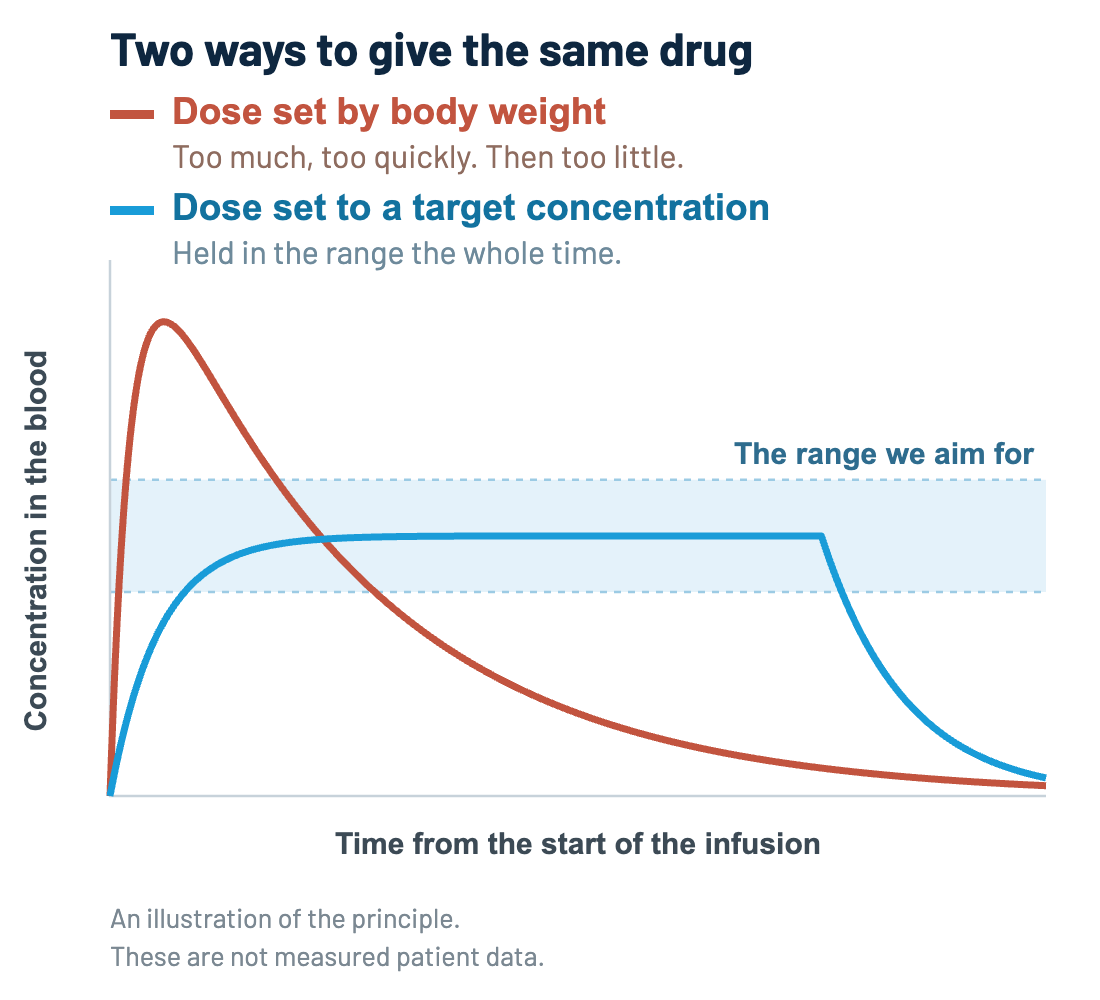
A weight-based dose overshoots, then leaves you short.
Your weight is not what decides how much ketamine ends up in your bloodstream. Ketamine dissolves readily into body fat, so of two people who weigh the same, the one carrying more fat has more of the drug pulled out of circulation and less of it reaching the brain. [8,12,13,14,15] Livers then clear it at speeds that differ several times over from one person to the next. [9]
So the same prescription lands differently in different people. Overshoot and the concentration climbs above the useful range — which is where the experience turns unpleasant, and where blood pressure and heart rate rise [10]. Undershoot and it never arrives there at all: the session passes uneventfully and very little changes afterward. Both are the same error in opposite directions, and neither is visible to anyone who is not aiming at a number.
How this is done
Seven stages. Four of them happen before you are anywhere near an IV.
This is the part that takes the time, and it is the part that decides the result. A standard infusion has one stage: give the drug.

Evaluation
We read everything before we decide anything
The complete record comes first — every medication trial, every prior treatment, what the side effects were and why things were stopped. If a course of ketamine has already failed you somewhere, we want its details. This is not a formality. A great deal of what will determine your response is already in that history.
Selection
We decide whether to treat you at all
Some conditions make ketamine unsafe, and one genetic variant makes it unlikely to work. Both are settled before you book travel or pay anything. Declining people we do not think we can help is the least commercial thing we do and the most important.
Optimization
We correct what the bloodwork finds, then treat
A full metabolic and hormonal work-up before treatment: complete blood count and metabolic profile, hsCRP, thyroid, estradiol and FSH/LH or testosterone by LC/MS, vitamin D, B12 and folate with homocysteine and methylmalonic acid, RBC magnesium and acetyl-L-carnitine. Where something on that list comes back low, we correct it first and then treat, rather than treating around it.
Target concentration
We work out the level the infusion is built to reach
Rather than calculating a milligram dose from your weight, we work out the level the infusion should reach and hold — from your body composition, how fast you clear ketamine, and what else you are taking. That level, not your weight, is what the infusion aims at. In complex cases a pharmacogenomic panel informs it, but only where the result would change what we do.
Delivery and observation
One patient, one physician, the whole infusion
The infusion runs in three stages at variable rates rather than one constant rate, which reaches the target sooner and holds it there. One patient at a time. The physician who set your dose gives it and stays for the whole of it, watching heart rate and heart rate variability, blood pressure, ECG and oxygen saturation — an anesthesiologist doing what anesthesiologists do.
Adjustment and refinement
Each day is set from the day before
The infusion is adjusted while it runs, in response to what is actually happening rather than to a preset. And each day is set from the one before: day one informs day two, day two informs day three. Three infusions given to an identical plan would be three separate appointments. Refining each one from the last is what makes them a course of treatment.
Follow-up and measurement
What happens afterward is measured, not remembered
You continue with the RESTORE supplement after the course, which is included in your fee, and complete the same symptom scales you filled in beforehand — so the result is measured rather than recalled. We send those results to your psychiatrist or prescriber, which we would generally prefer to do.
Before you spend anything
Not everyone should have this treatment.
Some conditions make ketamine unsafe. Every one of them is listed openly on this site, and you will hear about any that apply to you on the first call — before you travel, and before you pay anything.

Conditions that rule someone out entirely
- Heart and circulation. Rapidly worsening or uncontrolled high blood pressure, or unstable angina. A recent heart attack or stroke. An aneurysm or abnormal blood-vessel formation in the brain. Fibromuscular dysplasia. Narrowing of the aortic valve. Hypertrophic cardiomyopathy. Pulmonary hypertension.
- Inherited conditions. Polycystic kidney disease or vascular Ehlers-Danlos syndrome. Multiple endocrine neoplasia type 2.
- Mental health. Psychosis or schizophrenia. Delusional disorder or depersonalization disorder. A substance use disorder that is not in remission.
- Pregnancy, IVF treatment, or breastfeeding.
- A known allergy to ketamine.
And four things we will not do
- We will not treat you if we do not think you are likely to benefit.
- We will not treat you without reviewing your records first.
- We do not prescribe take-home ketamine in any form — no lozenges, no nasal spray, no oral formulation.
- We will not advise you to stop or reduce a psychiatric medication. That is your prescriber’s decision, and we will speak to them directly.
A separate and longer list — blood pressure, thyroid, liver and kidney disease, anticoagulants, benzodiazepines, lamotrigine — does not rule you out. Those change how treatment is planned, and we deal with them before the first infusion rather than during it.
About the Ketamine Research Institute
We do one thing. The Ketamine Research Institute in Sarasota, Florida provides ketamine-based infusion therapy and trains clinicians to deliver it. We do not offer other services, and we do not plan to.
That narrowness is deliberate. It is what makes it possible to treat one patient at a time, to keep a physician in the room for the whole of every infusion, and to score every patient before treatment and afterward, so that whether it worked is a question with an answer.
Gerald W. Grass, MD, Founder and Medical Director

An anesthesiologist by training, with a career spanning anesthesiology, neurosurgery, pain medicine and emergency medicine. He held a faculty appointment at Yale School of Medicine in anesthesiology and pain medicine and directed the Yale Pain Medicine Fellowship Program — at the institution where the first controlled trial of ketamine for depression was run.
He first used ketamine clinically in 1989, in his neurosurgical residency, and has worked with it ever since. He began treating private patients in 2006 and has given thousands of ketamine infusions, personally present for the whole of every one.
Before that, in 2005, holding a joint appointment at the Yale Department of Anesthesiology and Pain Medicine and at the VA, where he served as Chief of Pain Management, he began treating veterans returning from Iraq and Afghanistan — people carrying chronic pain, depression and post-traumatic stress at the same time. That work is where RESTORE began.
That range is visible in how the program is built. Aiming at a target blood concentration is a technique from anesthesiology. The concentration targets used for nerve pain come from pain medicine. The airway assessment and sedation monitoring that make it appropriate to give an anesthetic outside an operating room come from the same training.
He has also served as principal investigator on a multicenter randomized controlled trial of a new treatment for postpartum depression. Full background, academic history and publications →
Other physicians come here to learn this approach. Since 2016 the Institute has run an intensive training program in which licensed clinicians travel to Sarasota for classroom instruction and supervised clinical training in a working infusion suite. RESTORE itself is proprietary to this practice and is given only here. What clinicians take away is the KRI Precision Ketamine Infusion — the same principles of measured, individualized dosing, applied in their own practices. About the training program
Research and teaching
Dr. Grass is a published author and lecturer whose work includes peer reviewed articles, abstracts, book chapters, and educational presentations. He has presented his research at regional and national conferences and meetings, and to government agencies including the Veterans Administration and the Department of Defense. In 2016 he founded the Institute’s intensive training program for clinicians, which teaches the precision medicine and targeted infusion methods used here through classroom instruction and supervised clinical training in a working infusion suite.
Working with the physicians who already care for you

Ketamine therapy is one part of your care, not a replacement for it. You keep your psychiatrist, your primary care physician, and any specialist treating your pain. We are not asking you to choose between us and them.
We work with them directly. Before we treat you, we go over your history and every medicine you take with the clinician who prescribes it, because several common medicines change the way ketamine behaves in the body, and that has to be settled before an infusion rather than discovered during one [16]. Through your course of treatment and afterward, your own physicians get what they need from us to make their decisions well: what you were given, how you responded, and what we recommend next. We stay available to them for as long as you are our patient.
This coordination is part of the treatment, not a formality. Ketamine can change how a patient is doing within days rather than months, and the decisions that follow, about your other medicines, your therapy, and how closely you are watched, are made better by physicians who are working from the same information we are.
We do treat patients with active suicidal thinking, but only on the recommendation of their psychiatrist, and only with that psychiatrist continuing to co-manage their care.
Coming to Sarasota
Patients travel to us from across the country. The course runs over three days in a row, so you will need somewhere to stay. Airports, driving times, where people usually stay, and why we ask that you not drive yourself home after an infusion are all set out on the visiting page.Contact Us Today
800-850-6979
5969 Cattleridge Blvd - Suite 104 Sarasota, FL 34232 restore@ketamineinstitute.com
View our Terms of Service and Privacy Policy