Questions and answers

The questions people actually ask

Short answers about effectiveness, safety, cost and what the day involves — in plain language, with a link to the fuller explanation where one exists.
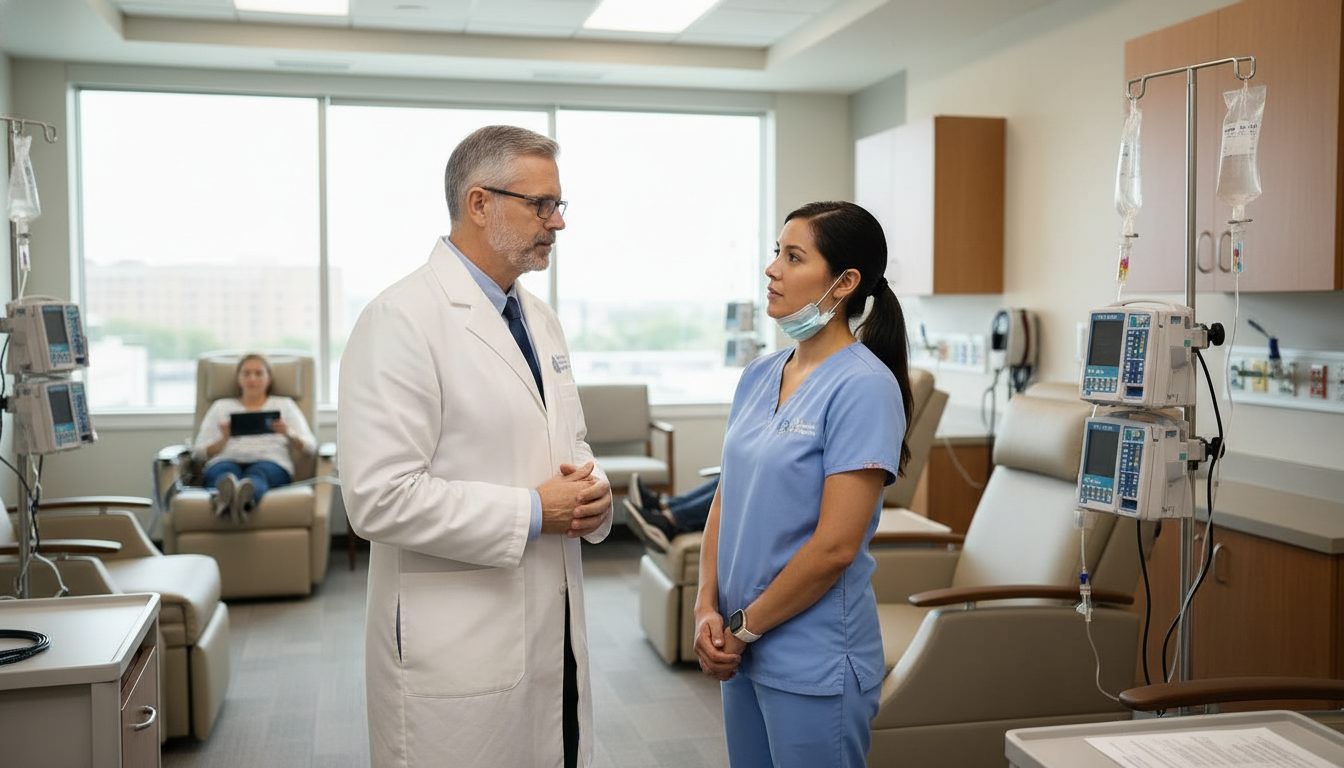
A physician and nurse in the infusion suite

Ketamine infusion therapy, dosed to a measured target...
The RESTORE Infusion Program

Does it work, and is it safe?

Is it effective?

For treatment-resistant depression, the most direct answer we have is our own. Between 2017 and 2022 we tracked 87 patients treated here with the RESTORE protocol, scored on the Beck Depression Inventory-II before treatment and again afterward.

Counting everyone who started, about 79% responded and about 51% reached remission. Counting only the 78 who completed the course, 88.4% responded and 56.3% reached remission. We give you both figures because the lower pair is the more honest guide to what to expect.

Responded means the score fell by at least half. Remission means it fell to 13 or below, the range the scale treats as minimal symptoms. Response is a substantial change. It is not the same as being well.

This is a retrospective review of one practice, with no control group, and it has not been peer reviewed. It is not a prediction of your result. Some people notice nothing at all, and we cannot tell in advance who they will be.

Our Results sets out the data in full, including what it does not show.

Is it safe?

Ketamine has been in clinical use as an anesthetic since the 1970s. Here it is given at sub-anesthetic doses, well below the dose used for surgery — but it is a potent drug and it is regulated as one.

A physician starts the intravenous line, runs the infusion and stays with you throughout, with continuous monitoring of heart rate, blood pressure and oxygen. One patient is treated at a time.

Safety, Risks and Limits covers this in detail, including the longer-term questions and what is still unknown.

What are the side effects?
  • Dissociation — a sense of detachment from your body or surroundings, and an altered sense of time. This is expected, and typically resolves within an hour of the infusion ending.
  • Transient rises in blood pressure and heart rate — one of the reasons monitoring is continuous.
  • Nausea, which can usually be prevented or treated.
  • Dizziness, blurred vision and unsteadiness for several hours afterward.
  • Feeling emotionally raw or unusually tired the following day.

Tell us about anything you experience, during or after. It changes how the next infusion is given.

Who is not a good candidate?

We will not treat you if we do not think you are likely to benefit, and we will not treat you without reviewing your records first.

We do not prescribe take-home ketamine in any form — no lozenges, no nasal spray, no oral formulation.

If you are having thoughts of suicide, tell us. We do treat patients with active suicidal thinking, but only on the recommendation of, and in ongoing co-management with, your psychiatrist. If you need help today, call or text 988 to reach the Suicide and Crisis Lifeline, or go to your nearest emergency department. Ketamine therapy is scheduled care and is not a substitute for emergency treatment.

Are You a Candidate?

What it costs

What does it cost?

The first call is free. A consultation with the physician is $150, and it is credited against your program fee if you go ahead.

  • RESTORE Essential — $3,450 for the initial course; $775 for each maintenance infusion
  • RESTORE Rescue — $3,950 for the initial course; $775 for each maintenance infusion
  • RESTORE Advanced — $4,950 for the initial course; $875 for each maintenance infusion

You get a written estimate of your expected first-year cost before you commit, so that you are comparing a total rather than a headline.

Fees

Is it covered by insurance?

No. Ketamine infusion therapy for these conditions is not currently covered, and we do not bill insurance directly. That may change in the future.

We give you a receipt — a superbill — that you can submit to your insurer yourself. Patients often do obtain some reimbursement this way, though we cannot promise it and the amount varies by plan.

What is billed separately?
  • Laboratory studies, which you arrange through your own physician or laboratory
  • Pharmacogenomic testing where we recommend it — ordered and billed independently, and we have no affiliation with the testing company
  • Maintenance infusions after the initial course
  • Travel and accommodation

Before, and on the day

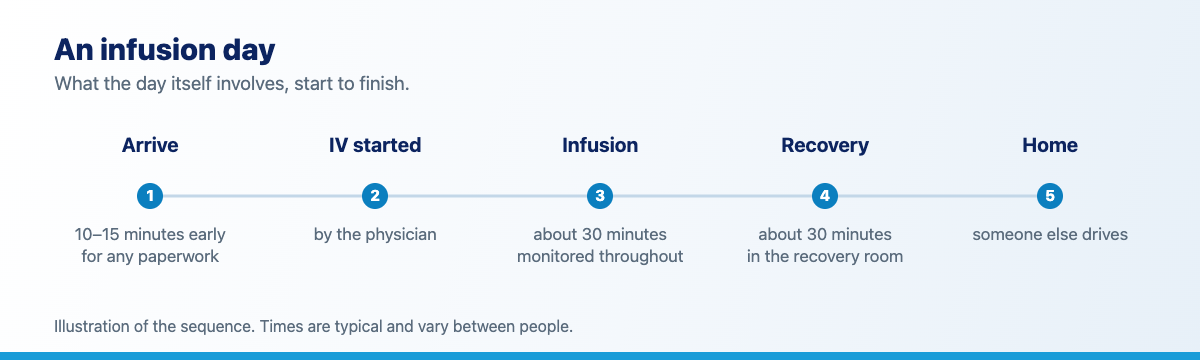
Illustration of an infusion day: arrive ten to fifteen minutes early, IV started by the physician, about a thirty minute infusion with monitoring throughout, about thirty minutes in recovery, then driven home
What do I need to do before coming in?
  • Arrive 10 to 15 minutes early, so there is time for any paperwork.
  • Wear comfortable clothing.
  • No solid food for six hours before an infusion. Clear fluids are fine up to two hours before.
  • Continue your routine medications as you normally would, unless we have specifically asked you to hold something.
  • Bring anything that makes you more comfortable — a pillow, a blanket, eye shades.
  • You will not be able to drive afterward, so arrange your ride before you come.

We send you a written instruction sheet before your first visit. If anything on it is unclear, call us — we would rather answer the question than have you guess.

Who will be with me during the infusion?

A physician. He starts the intravenous line, runs the infusion, and stays with you through the infusion and the early part of recovery.

One patient is treated at a time. You are not left alone and you are not one of several people being watched at once.

Do I need to bring someone with me?

You will not be able to drive after an infusion, so the simplest arrangement is to bring someone who can drive you home.

If that is not possible, tell us in advance and we will help you arrange transport.

How long does each infusion take?

The infusion itself takes about 30 minutes. Afterward you rest for about 30 minutes in the recovery room before going home.

Allow a couple of hours at the center from arrival to leaving.

Afterward
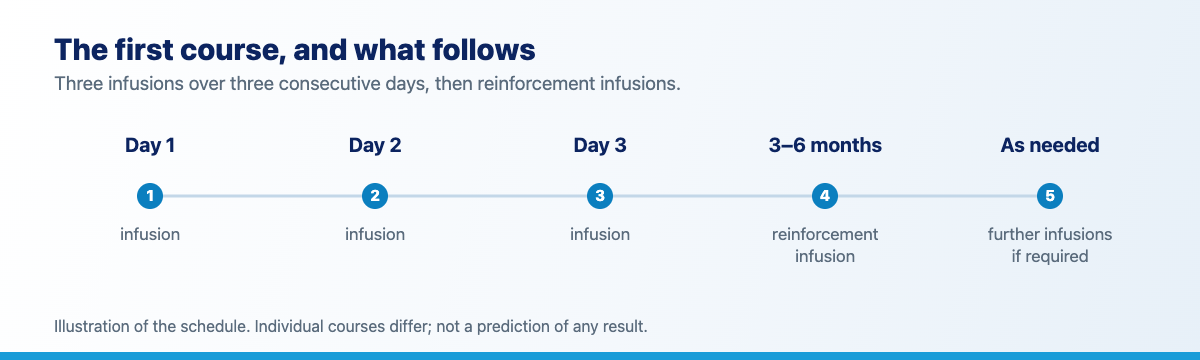
Illustration of the schedule: three infusions on three consecutive days, a reinforcement infusion at three to six months, and further infusions if required
How long will it last?

In our own review of 87 patients, the average interval between finishing the course and needing a further infusion was about eight months — a mean of 245 days.

That is an average drawn from a retrospective review of our own patients, with no control group, and it has not been peer reviewed. Some people need another infusion sooner, some go considerably longer. It is not a prediction of what will happen to you.

How often will I need to come back?

The first course is three infusions on three consecutive days. Most patients who respond then have two reinforcement infusions during the first year, usually at three to six months.

After that, it depends on how you are actually doing. You are scored on the same validated scale each time, so the decision is based on a measurement rather than an impression.

Will I need this for the rest of my life?

We do not know, and anyone who tells you they do is guessing. Ketamine is not a cure and we do not describe it as one.

What we can tell you is the pattern we see: an initial course, reinforcement infusions during the first year, and after that a schedule set by how you are doing rather than by a fixed rule.

Talk to us

Still have a question?

800-850-6979

The first call is free, and you will speak to someone who can answer clinical questions rather than take a message.

RESTORE — ketamine therapy, done precisely.
Ketamine infusion therapy in Sarasota, Florida
The RESTORE Infusion Program


RESTORE Ketamine Infusion Therapy

Contact Us Today!
We look forward to speaking with you!

Consult with our experienced team to determine if RESTORE is right for you.  Please get in touch with us at 800-850-6979 for more information.