
We train the clinicians who do this work.
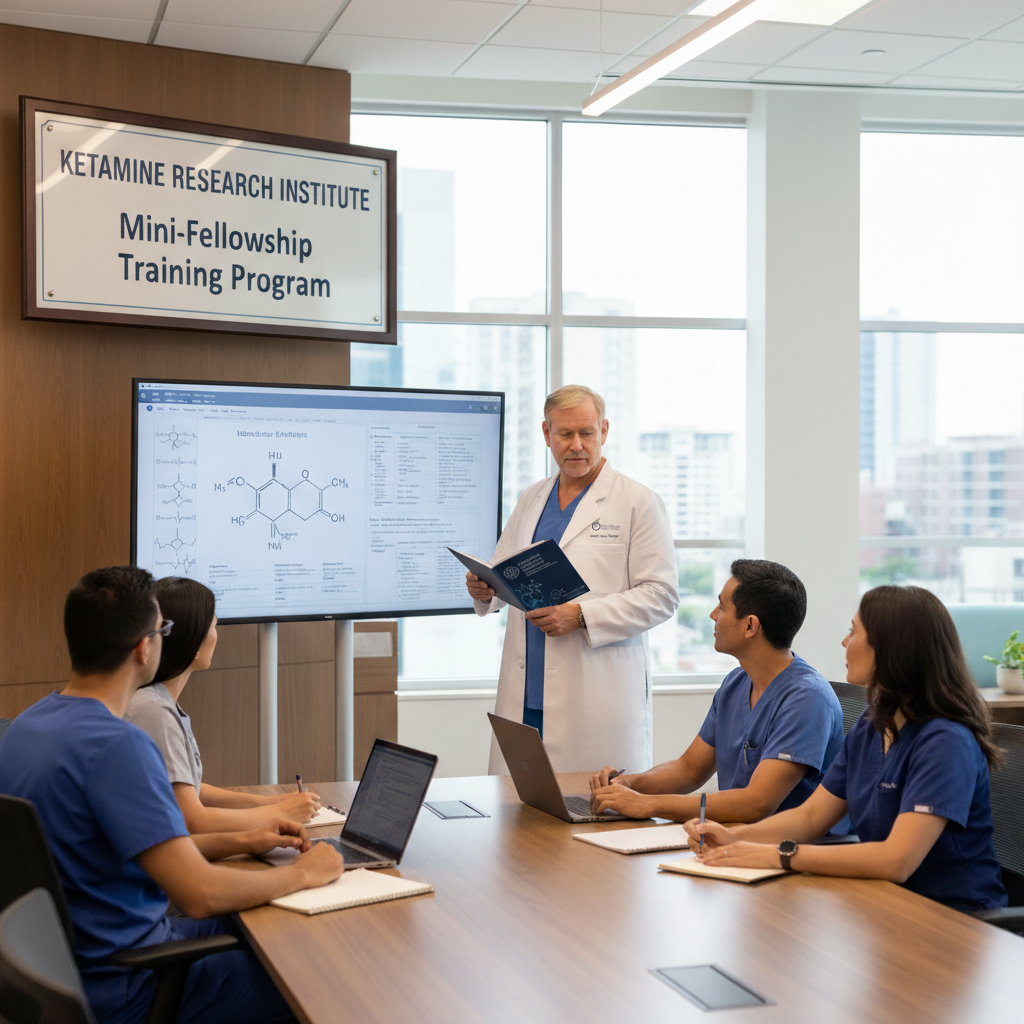
The Ketamine Research Institute runs a four-day intensive for licensed clinicians, followed by twelve months of mentorship. It is taught here, in the room where the infusions happen.
The program in brief
Four days, four clinicians, in a working infusion center.
15
Modules across four days
Pharmacology, pharmacokinetics, regulation, safety and the systems a practice runs on. Taught as a seminar, Thursday to Sunday.
4
Clinicians to a session
Twelve places a year. Everyone takes a history, calculates a dose, places a line, programs the pump and watches a recovery.
26
Type II CME credits
Then twelve months of mentorship, quarterly milestones, and a competency re-assessment at the end of the year.
Why this is on a patient’s website
A method is only as good as the people using it.
Patients sometimes ask why we teach other clinicians. We would rather teach our method openly than keep it. What we ask of a trainee is what we do here every day: the full record read before anyone is accepted, the dose worked out from a target concentration in the blood rather than from body weight, and a physician who stays in the room for the whole infusion.
The mark names the Institute that provided the training. That is the whole of what it claims.
What the training covers
Taught, and then observed.
- Dosing to a measured target concentration rather than to the scale.
- Monitoring and sedation standards taken from anesthesia practice.
- Choosing patients, and declining the ones this does not suit.
The practicum is supervised and peer-to-peer. Participants consent to treat one another, and no patients are involved. Receiving an infusion is voluntary, separately consented, and has no bearing on the assessment or the certificate.
The assessment has four parts: a 100-question written examination, skill stations, eight case scenarios, and a review of your documentation and charts.
The credential, and its limits
A certificate of training.
Clinicians who pass the assessment may say they were trained by this Institute, may be listed in our directory, and re-attest each year to the published Standard. It is a certificate of training. It is not a board certification, and no national body accredits ketamine training programs.
What we teach, and what we do here
The KRI method travels. The RESTORE program does not.
Clinicians who train here learn the KRI precision method in full: dosing to a measured target concentration, the monitoring standard that goes with it, and the work-up that comes first. It is a complete method, and they take it home and use it in their own practices.
RESTORE begins where that method ends. It is the program this Institute built around it, and it runs only in Sarasota. Three infusions over three days in a single visit, each one adjusted to how the patient responded to the one before rather than repeated unchanged. One patient at a time, with a physician in the room for the whole infusion and the early recovery. Scored before and after on a validated scale, so the result is measured rather than discussed.
It also includes elements developed here that are not taught, not licensed, and not published. That is why RESTORE is available in only one place.
We do not publish how the program is built. We do publish what it produced: 87 consecutive patients treated for treatment-resistant depression between 2017 and 2022, scored before and after on a validated scale, with the limits of that data set out beside it. Patients fly to Sarasota for it rather than drive to something closer to home.
What the program produced, and its limitations →
How the dosing is calculated →
What we hold ourselves to
We published the standard, so you can read it.
The KRI Standard for Office-Based Ketamine Therapy sets out, in numbered requirements, who must be in the room, what is monitored, how patients are selected and consented, how a dose is determined, when a series stops, and what is recorded. It is free to read, it is revised every year, and the clinicians we train attest to it annually.
It is a voluntary standard — not a law, and not an accreditation. Publishing it is the point: you can check what we say we do against what we wrote down.
We also filed a public comment on the federal docket for clinician training, arguing that competence in this work should be assessed rather than assumed from attendance. A comment is a public document that anyone may file; it is not an approval or an endorsement. Read the comment →
If you are a clinician
The full program is on our training site.
The curriculum, the four days in detail, the practicum, the mentorship year and the competency assessment. Tuition is $8,950, and it includes the Clinical Companion app, the Clinical Reference Manual and the KIRT-S screening tool.