
What to expect
What an infusion day is like
This page describes what the day itself involves — arriving, the infusion, and going home afterward. Whether the treatment helps you is a separate question, and one we answer honestly before we accept you.
Beforehand
Before you arrive
Most people arrive carrying several feelings at once: anxiety, hope, doubt, or all of them together. The anxiety is usually about the unknown — will it hurt, how will I feel, and will it work. The hope is about the possibility of relief after a long time without it. Both are normal, and you will not be the first person to walk in feeling all of it.
We answer questions before you travel, not just when you get here. If you need help planning the trip we are glad to give it — where to stay, how to get around, and somewhere quiet to go afterward.
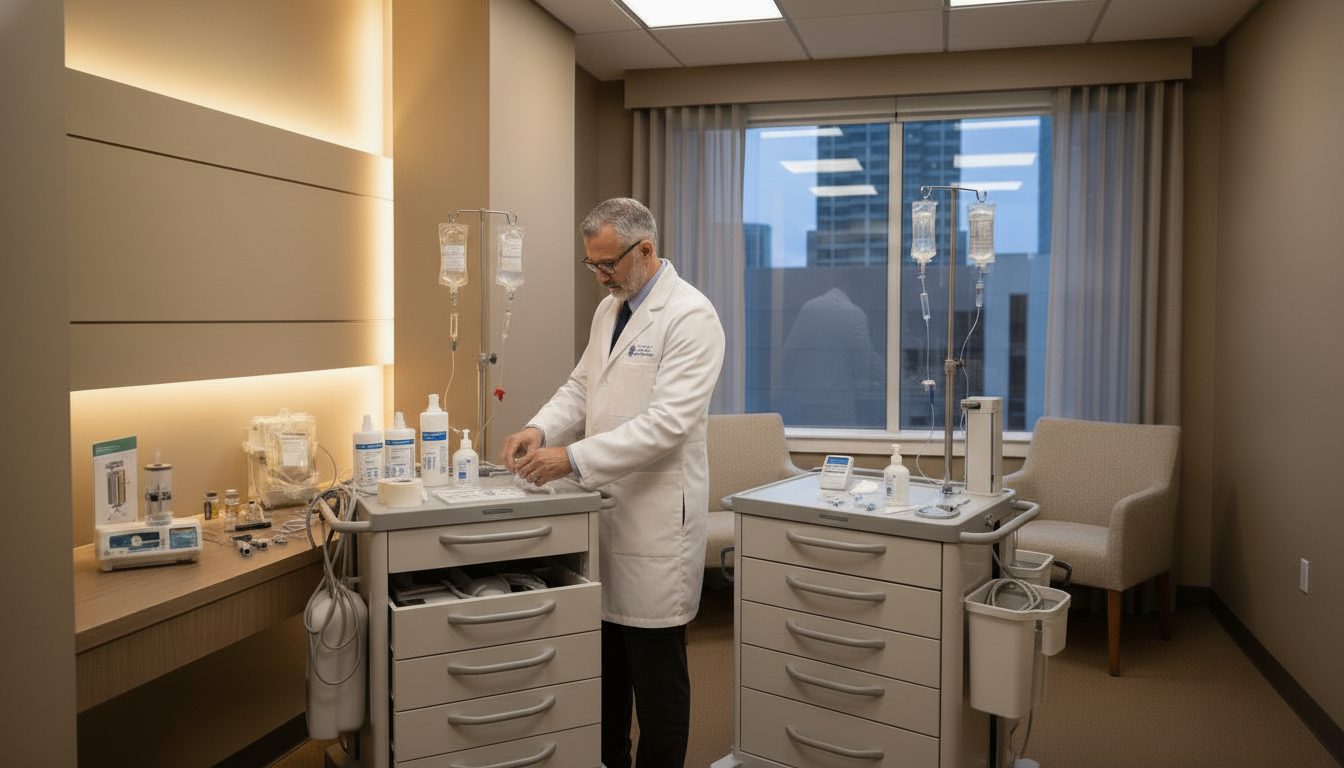
A private room, a reclining chair, and the equipment needed for the infusion.
Arriving
At the infusion center
The room is calm and deliberately low-key: dimmed lighting, quiet music, comfortable seating. You hand over your paperwork and the questionnaires about how you have been, and then the work is finished for the day. There is nothing else you have to do.
When you are ready you move to a private room with a reclining chair and the equipment needed for the infusion. The physician who treats you reviews your records, examines you briefly, starts the IV and attaches the monitors. He explains each step as he goes and answers whatever you want to ask.
He stays with you for the whole infusion. You are welcome to have someone in the room, and you will not be left alone at any point. If you bring someone, he will ask them not to start conversation unless you do — not out of formality, but because most people would rather be left to it.
During
The infusion itself
Most people notice the effect within minutes of it starting. It is difficult to put into words. You begin to feel differently about yourself and about the world around you. Many people describe a deep sense of calm, and some compare it to a deep meditation.
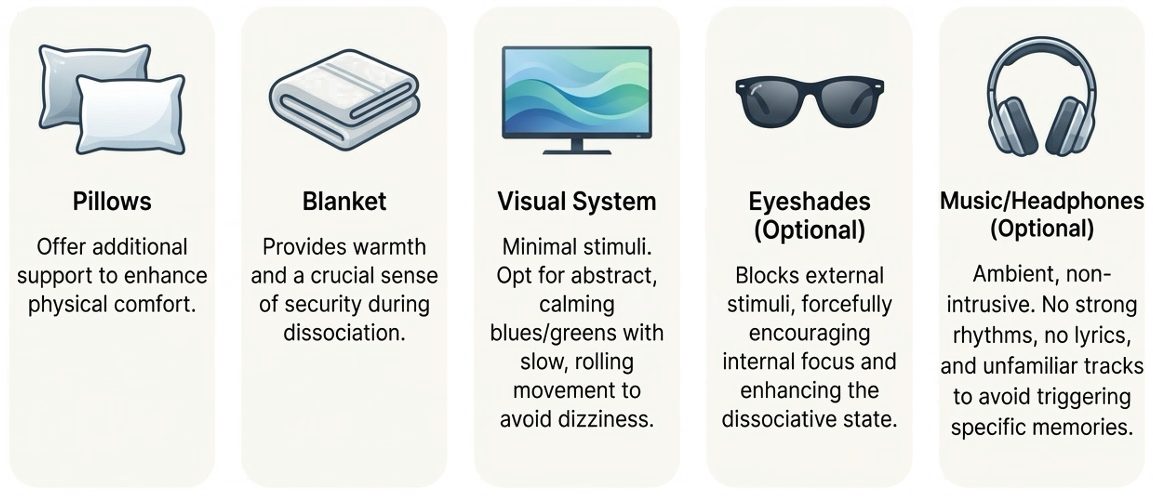
What is available during the infusion, if you want it.
Not everyone experiences it that way, and some people find the dissociation unpleasant. If that is how it is going for you, say so. The rate can be changed while the infusion is running.
Many patients listen to music. Pillows, a blanket and eyeshades are there if you want them.
Across the three days
What a response looks like, when it happens
The first course is three infusions over three days. People who respond usually notice the change across that period rather than all at once.
When it works, people often describe going back to things they had let go of: seeing friends and family, taking up activities again, feeling more alert. That is what a response looks like when it happens.
The good news, from our own review of 87 patients treated here for treatment-resistant depression between 2017 and 2022: about eight in ten responded, meaning their depression score fell by at least half. The bad news: about two in ten did not, and we cannot tell in advance who they will be.
Responding is not the same as being well, and a review of our own past patients is not a prediction of your result. The full numbers, and their limits, are on our results page.
You are scored on a validated rating scale before treatment and again afterward, so the answer to whether it worked is a measurement rather than an impression.
Afterward
Getting home
After the infusion you rest for about thirty minutes in the recovery room. Then you are free to go — but you will not be able to drive yourself, so the simplest thing is to bring someone who can drive you. If that is not possible, tell us and we will help arrange transport.
For the first four to six hours you will be in a relaxed state, so no driving, no machinery, and nothing that needs a signature. Many people prefer to rest quietly for a while. After that it depends entirely on how you feel: some go to the gym or a yoga class, others take a walk on the beach and have a quiet dinner.
A practical note
What to tell friends and family
Ask them not to bombard you with questions afterward. They will want to know — did it work, do you feel better — and the effects can be subtle at first. Many people have trouble putting the experience into words, and even those who sense an immediate change often cannot articulate it straight away.
Those questions feel easy to the person asking. To you they can be complicated in ways that are hard to explain, and they can leave you feeling you are about to disappoint someone. Tell them in advance that you will talk about it when you are ready, and that it might take a few days.
Talk to us
Questions about the day itself?
Ask us anything about what happens and when. It is easier to arrive knowing.
RESTORE — ketamine therapy, done precisely.