
Physician-led ketamine infusion therapy
The RESTORE Method
What we actually do, and why each step is there.
Ketamine is FDA-approved as an anesthetic. It is not FDA-approved for depression, anxiety, PTSD, or chronic pain, and its use for those conditions is off-label. Individual results vary and cannot be predicted in advance.
Mechanism
How ketamine works
Ketamine blocks a receptor in the brain called the NMDA receptor. That produces a short-lived rise in glutamate, the brain’s main excitatory signaling chemical, and sets off a chain of events linked to the growth of new connections between nerve cells.4,5 Ketamine also acts at a large number of other targets, which is one reason its effects are hard to sum up in a sentence.6,7
The understanding of depression that best fits these findings is not a simple chemical shortage. It is a problem in the communication between regions of the brain. Ketamine appears to act on that communication, and that offers one explanation for its unusual timing.
Conventional antidepressants generally take several weeks to work. Ketamine has been shown to produce measurable improvement within hours. In a controlled trial in treatment-resistant depression, seventeen of eighteen patients improved significantly within two hours of a single infusion, and 71 percent met the criteria for response at twenty-four hours.8 A later trial at two sites confirmed the finding.9
Why we do it differently
The problem with dosing by body weight
In 2000, a Yale research group published the first controlled evidence that a single intravenous ketamine infusion could rapidly reduce depressive symptoms.1 The dose they used, 0.5 mg/kg over forty minutes, was chosen to answer a research question. It became the standard by repetition rather than by optimization, and most clinics still use it.
Three things it does not account for:
- Body composition. Ketamine is highly lipophilic. It partitions into fat rather than remaining in circulation, so the same milligram-per-kilogram dose produces materially different blood concentrations in two people of the same weight and different composition
- Metabolism. Hepatic CYP450 activity varies widely between individuals, and it determines both how quickly ketamine is cleared and how much of it becomes the secondary metabolites associated with longer-acting effects
- Everything else you are taking. Several common psychiatric medications interact with the response
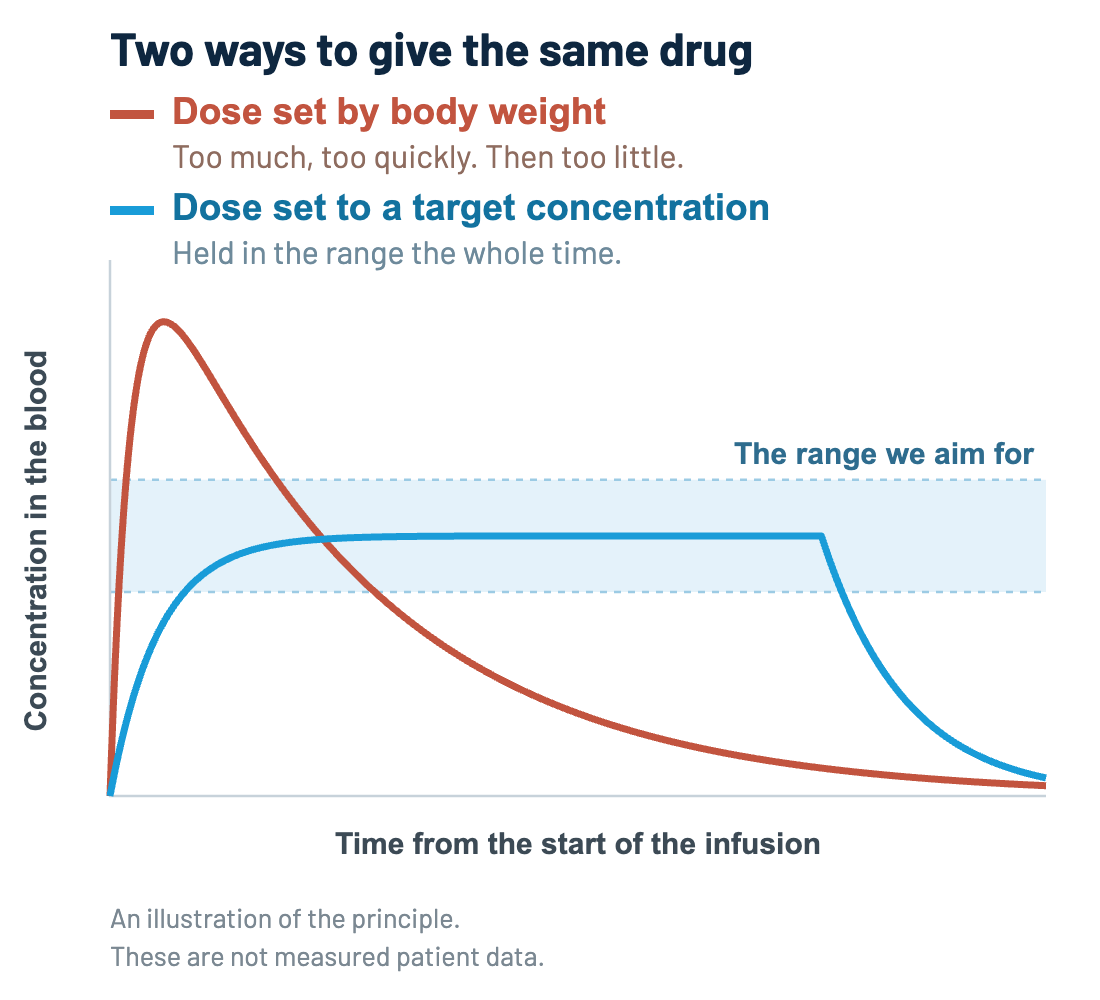
An illustration of the principle. These are not measured patient data.
Step one
Measure
Before we accept you for treatment we review your records and your laboratory studies. Where they are missing or out of date we ask for:
- Complete blood count with differential, and a comprehensive metabolic profile
- hsCRP
- Thyroid profile
- Estradiol and FSH/LH, or free, direct and total testosterone by LC/MS
- Vitamin D, B12 and folate, with homocysteine and methylmalonic acid
- RBC magnesium
- Acetyl-L-carnitine
Two of these matter more than the others. Low acetyl-L-carnitine has been associated in the research literature with poor antidepressant response. Magnesium acts at the same NMDA receptor site as ketamine. Where either is low we correct it before treatment rather than treating around it.
Step two
Profile, where it will change the plan
In more complicated presentations — several failed medication trials, unusual side-effect histories, or a prior ketamine course that did not work — we may recommend a commercially available pharmacogenomic panel.
We order one when the result would change what we do. We do not order it routinely, we have no affiliation with any testing company, and it is billed independently of your treatment fee.
Step three
Dose to a concentration
Rather than calculating a fixed milligram dose from your weight, we model the serum concentration your infusion should reach and maintain, and adjust delivery to hold it there.
The infusion is given in three stages at variable rates rather than at one constant rate, which reaches the target concentration sooner and holds it longer. The idea of aiming for a blood level rather than a milligram figure comes from anesthesia, where drugs have been given to a calculated target concentration for decades.10
The dose is calculated on adjusted body weight rather than total body weight.2,3,11,12,13 This is the single largest difference between RESTORE and the schedule most patients encounter, and it is what makes a shorter, more concentrated course workable.
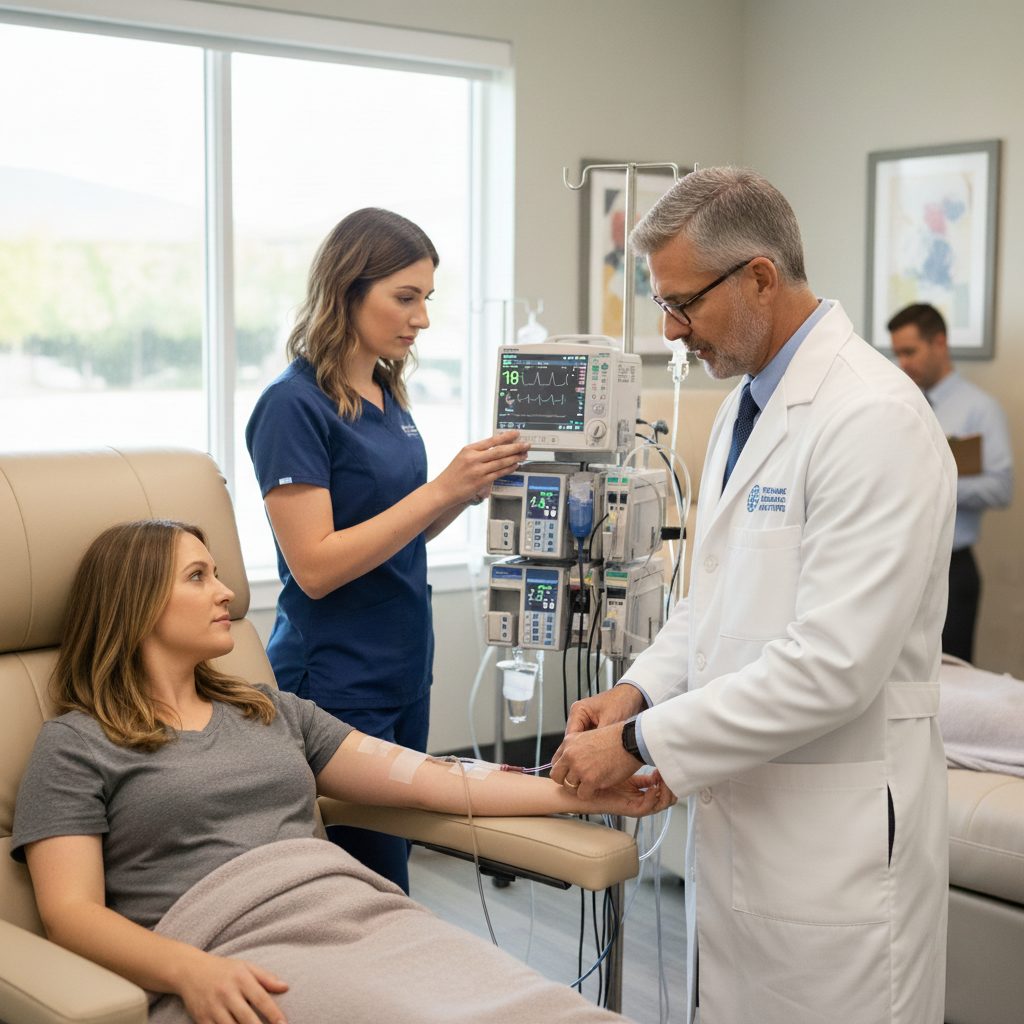
The rate is adjusted during the infusion rather than set once and left.
Step four
Stay in the room
The physician who treats you performs each infusion and remains present for its entire duration. We treat one patient at a time. Throughout the session we monitor heart rate and heart rate variability, blood pressure, ECG and oxygen saturation, and adjust the infusion in response to what we are seeing rather than running it to a preset.
I stay in the room for every minute of your infusion. I am watching two things at the same time. The first is your physiology: your blood pressure, your heart rate, your breathing, the oxygen and carbon dioxide you are moving. The second is how you are actually doing, which I ask you about as we go, because no monitor can tell me that part.
Both of those can change while an infusion is running, and both can be acted on. If your blood pressure rises, I manage it. If the experience is becoming more than you want it to be, I can change the rate. Those decisions get made while it is happening, not reviewed afterward.
This is also why we can respond if something goes wrong. The physician who treats you trained in anesthesiology and in pain medicine; airway and sedation management is core competence rather than an add-on.
Step five
Afterward
You take the RESTORE supplement after the course, which is included in your fee. We ask you to complete the same symptom scales you completed before treatment, so that what happens next is measured rather than remembered.
We send your results to your psychiatrist or prescriber if you would like us to, and we would generally prefer to.
The course
What the schedule looks like
You are scored on a validated rating scale before treatment and at intervals afterward. That way, whether the treatment is working is a question with an answer. It also means a further infusion happens when the score says it is due, rather than when a month has gone by. We cannot tell you in advance which pattern will be yours.
See what our own outcome data shows, and what it cannot tell you
Provenance
How this program was developed
RESTORE was not taken from a protocol found in the literature and put into practice. It was built here, over a long stretch of clinical work with ketamine that began before anyone was using the drug for depression at all.
1989. The Institute’s founder first used ketamine clinically during a neurosurgical residency, and went on using it through his training in emergency medicine and in anesthesiology. At that time ketamine was an anesthetic and nothing more. Its effect on depression had not yet been described.
2000. The first controlled trial of ketamine in depression was published from Yale.1 He later held a faculty appointment in anesthesiology and pain medicine at that institution and directed its Pain Medicine Fellowship Program.
2005. Holding a joint appointment at the Yale Department of Anesthesiology and Pain Medicine and at the Veterans Administration Department of Anesthesiology, where he served as Chief of Pain Management, he began treating veterans with ketamine.
2016. He founded the Institute’s intensive training program, so that the method could be taught rather than kept.
Sixty months of measurement. Outcomes for eighty-seven patients treated for treatment-resistant depression were scored on a validated rating scale and reviewed as a group, with the response rates, the remission rates and the average interval before a further infusion was needed all set out on our results page, together with the limits of that kind of review.
The three-day course is the end of that process, not the beginning of it.
References
1. Berman RM, Cappiello A, Anand A, et al. Antidepressant effects of ketamine in depressed patients. Biol Psychiatry. 2000;47(4):351–354. PMID 10686270.
2. Abuhelwa AY, Somogyi AA, Loo CK, et al. Population pharmacokinetics and pharmacodynamics of the therapeutic and adverse effects of ketamine in patients with treatment-resistant depression.
3. Peltoniemi MA, Hagelberg NM, Olkkola KT, Saari TI. Ketamine: a review of clinical pharmacokinetics and pharmacodynamics in anesthesia and pain therapy.
4. Li N, Lee B, Liu RJ, et al. mTOR-dependent synapse formation underlies the rapid antidepressant effects of NMDA antagonists. Science. 2010;329(5994):959–964.
5. Krystal JH, Kavalali ET, Monteggia LM. Ketamine and rapid antidepressant action: new treatments and novel synaptic signaling mechanisms. Neuropsychopharmacology.
6. Zanos P, Gould TD. Mechanisms of ketamine action as an antidepressant. Mol Psychiatry. 2018;23(4):801–811. PMID 29532791.
7. Zanos P, Moaddel R, Morris PJ, et al. Ketamine and ketamine metabolite pharmacology: insights into therapeutic mechanisms. Pharmacol Rev. 2018;70(3).
8. Zarate CA Jr, Singh JB, Carlson PJ, et al. A randomized trial of an N-methyl-D-aspartate antagonist in treatment-resistant major depression. Arch Gen Psychiatry.
9. Murrough JW, et al. Antidepressant efficacy of ketamine in treatment-resistant major depression: a two-site randomized controlled trial.
10. Target-controlled infusion, past, present, and future. J Anaesthesiol Clin Pharmacol. 2024. PMID 39391641.
11. Ingrande J, Lemmens HJM. Dose adjustment of anaesthetics in the morbidly obese. Br J Anaesth. 2010;105(Suppl 1):i16–i23. PMID 21148651.
12. Erstad BL, Barletta JF. Drug dosing in the critically ill obese patient. Crit Care. 2020;24:315.
13. Green B, Duffull SB. What is the best size descriptor to use for pharmacokinetic studies in the obese? Br J Clin Pharmacol. 2004;58(2):119–133.
Related pages
Conditions We Treat Are You a Candidate? Safety, Risks and Limits Our Results Fees
Talk to us
Find out whether this is right for you.
We will go through your history and your records and tell you honestly whether a course here is likely to help.
RESTORE — ketamine therapy, done precisely.