
The RESTORE Method
What we actually do, and why each step is there.
Ketamine is FDA-approved as an anesthetic. It is not FDA-approved for depression, anxiety, PTSD, or chronic pain, and its use for those conditions is off-label. Individual results vary and cannot be predicted in advance.

The problem with dosing by body weight
In 2000, a Yale research group published the first controlled evidence that a single intravenous ketamine infusion could rapidly reduce depressive symptoms. The dose they used — 0.5 mg/kg over forty minutes — was chosen to answer a research question. It became the standard by repetition rather than by optimization, and most clinics still use it.
Three things it does not account for:
- Body composition. Ketamine is highly lipophilic. It partitions into fat rather than remaining in circulation, so the same milligram-per-kilogram dose produces materially different blood concentrations in two people of the same weight and different composition.
- Metabolism. Hepatic CYP450 activity varies widely between individuals, and it determines both how quickly ketamine is cleared and how much of it becomes the secondary metabolites associated with longer-acting effects.
- Everything else you are taking. Several common psychiatric medications interact with the response.
Step one — measure
Before we accept you for treatment we review your records and your laboratory studies. Where they are missing or out of date we ask for:
- Complete blood count with differential, and a comprehensive metabolic profile
- hsCRP
- Thyroid profile
- Estradiol and FSH/LH, or free, direct and total testosterone by LC/MS
- Vitamin D, B12 and folate, with homocysteine and methylmalonic acid
- RBC magnesium
- Acetyl-L-carnitine
Two of these matter more than the others. Low acetyl-L-carnitine has been associated in the research literature with poor antidepressant response. Magnesium acts at the same NMDA receptor site as ketamine. Where either is low we correct it before treatment rather than treating around it.
Step two — profile, where it will change the plan
In more complicated presentations — several failed medication trials, unusual side-effect histories, or a prior ketamine course that did not work — we may recommend a commercially available pharmacogenomic panel. We order one when the result would change what we do. We do not order it routinely, we have no affiliation with any testing company, and it is billed independently of your treatment fee.
Step three — dose to a concentration
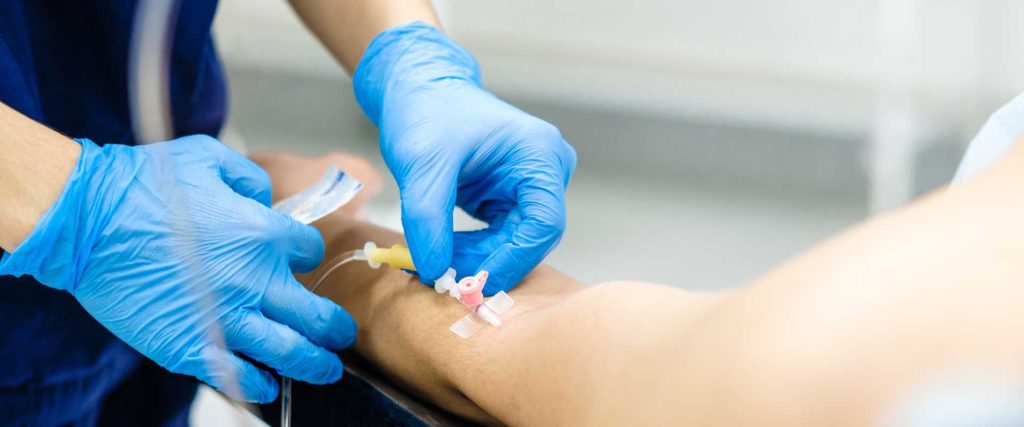
Rather than calculating a fixed milligram dose from your weight, we model the serum concentration your infusion should reach and maintain, and adjust delivery to hold it there. The infusion is given in three stages at variable rates rather than at one constant rate, which reaches the target concentration sooner and holds it longer.
Magnesium is given alongside the ketamine. It is a cofactor at the same receptor and its timing relative to the ketamine matters, so it is given in a fixed relationship to the infusion rather than as a routine additive.

Step four — stay in the room
Dr. Grass performs each infusion himself and remains present for its entire duration. We treat one patient at a time. Throughout the session we monitor heart rate and heart rate variability, blood pressure, ECG and oxygen saturation, and adjust the infusion in response to what we are seeing rather than running it to a preset.
This is also why we can respond if something goes wrong. Dr. Grass is an anesthesiologist by training; airway and sedation management is core competence rather than an add-on.
Step five — afterwards
You take the RESTORE supplement after the course, which is included in your fee. We ask you to complete the same symptom scales you completed before treatment, so that what happens next is measured rather than remembered. We send your results to your psychiatrist or prescriber if you would like us to, and we would generally prefer to.
The course
Three infusions on three consecutive days. Two reinforcement infusions two to three months later, then a reassessment. After that most patients need one infusion once or twice a year. We cannot tell you in advance which pattern will be yours.
See what our own outcome data shows, and what it cannot tell you →
Related pages
Conditions We Treat · Are You a Candidate? · Safety, Risks and Limits · Our Results · Fees