
Comparing approaches
How the two methods differ
Ketamine is ketamine. What changes between one clinic and another is how the dose is decided, how it is delivered, and what gets measured.
This page sets those differences out plainly. It does not tell you that one produces better results than the other, because no study has compared them.
The two approaches, side by side
| Infusion details | The weight-based method | The RESTORE method |
|---|---|---|
| How the dose is set | Body weight: half a milligram per kilogram | Calculated to reach a target level in the brain, set for your body chemistry |
| During the infusion | A fixed rate over forty minutes | Watched continuously and adjusted as needed to keep you comfortable and safe at your target level |
| The course | Six infusions across about two weeks | Three infusions on three consecutive days |
| Before the first infusion | Usually a health questionnaire, history and vital signs; bloodwork is often not required | Your records and bloodwork reviewed, and what the bloodwork finds corrected first |
| Your other medications | May be reviewed for safety, but not factored into the dose | A required review of every medication you take and how each interacts with ketamine, factored into your dose |
| Who is in the room | Often a nurse, with a physician or nurse practitioner on site or on call | An anesthesiologist, for the whole infusion, the same physician each day |
| Patients treated at a time | Often several, monitored by the same staff | One |
| Measuring the result | Varies by clinic | A validated scale before treatment and again afterward |
| After the first course | Typically, maintenance infusions every three to four weeks to sustain the effect | Two reinforcement infusions two to three months later |
This sets out how the two methods differ. It is not a comparison of results. Individual results vary, and no treatment helps everyone.
Where the weight-based dose came from
The first randomized, placebo-controlled trial of ketamine in treatment-resistant depression was published in 2000 by a group in the Yale Department of Psychiatry.1 The dose it used, 0.5 mg/kg infused over forty minutes, was chosen to test whether an antidepressant effect existed at all.
It was a research dose, and it answered the question it was designed to answer. That schedule has been carried forward in the literature ever since, and it is the one most clinics use today.
It is worth being clear about what those early studies set out to do. They were designed to establish whether ketamine had an antidepressant effect at all. They were not designed to work out how to make that effect last, and they do not claim to have been. The protocol in common use is the answer to the first question, not the second.
Dosing by body weight is how a great many medicines are prescribed, and for most of them it works perfectly well. What body weight does not describe is how much of a given dose actually reaches the brain in a particular person.
1. Berman RM, Cappiello A, Anand A, et al. Antidepressant effects of ketamine in depressed patients. Biol Psychiatry. 2000;47(4):351–354. PMID 10686270.
Three things that change how much reaches the brain
These are the reasons two people given the same milligrams per kilogram can end up with quite different concentrations in the blood.
Ketamine distributes into fat. Two people who weigh the same but carry different proportions of body fat will not reach the same blood concentration from the same dose. Weight on its own does not describe that difference.
Several medications interact with ketamine, either at the receptor or through the way it is metabolized. They include lamotrigine, risperidone, olanzapine, benzodiazepines and naltrexone. Others are reviewed case by case.
The lamotrigine evidence in particular is mixed rather than settled. Our preference is that patients we accept are not taking it at the time of their infusions, and that is a decision for the clinician who prescribes it.
Ketamine is broken down by liver enzymes whose activity varies between individuals, partly on genetic grounds. The same dose can be cleared quickly in one person and slowly in another, which changes both the concentration reached and how long it is held.
What the RESTORE method does instead
The dose is calculated to reach and hold a target level in the brain, using pharmacokinetic modeling that takes the factors above into account rather than weight alone.
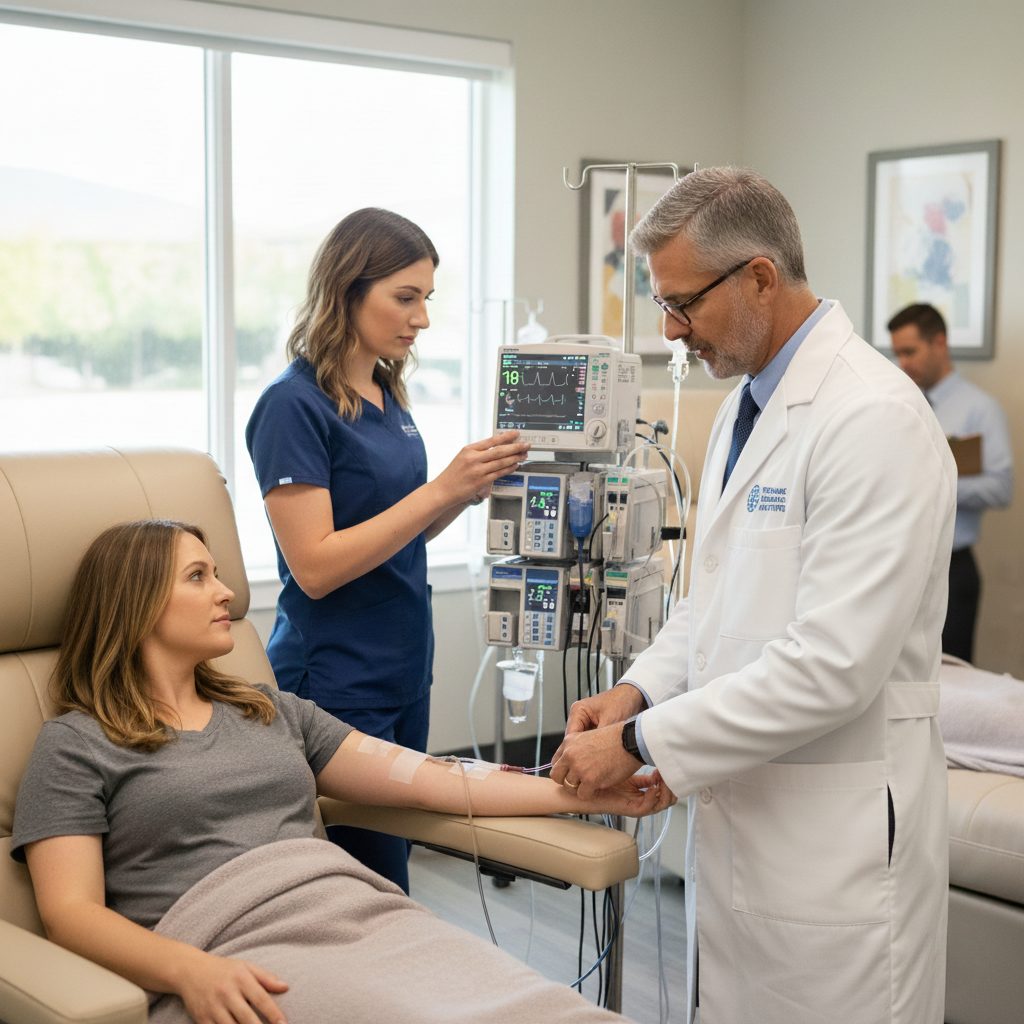
The infusion runs in stages rather than at one fixed rate, and Dr. Grass adjusts it as needed based on how you respond, so you reach your target level comfortably and safely.
Before treatment there is a metabolic assessment, and pharmacogenomic testing where the result would change what we do.
Scores on a validated scale are taken before and after, so whether it worked is a measurement rather than an impression.
What this page does not tell you
It does not tell you that one method produces better results than the other. No study has compared them directly, and a difference between two uncontrolled sets of numbers is not a measure of how much better one treatment is than another.
What it tells you is how the two differ in what is decided, what is delivered and what is measured. Those are real differences, and you are in a position to weigh them yourself.
Our own outcomes, and their limitations, are set out in full on the results page.
Our results, and how to read them Safety, risks and limits What to Ask a Clinic
Talk to us
Not sure which of these is right for you?
Tell us what you have already tried and we will tell you honestly whether this is likely to help, including when the answer is no.
RESTORE — ketamine therapy, done precisely.