
For clinicians
How to start a ketamine clinic
What it costs, what the law requires, how long it takes to break even, and the mistake that closes most new practices. Written by the physician who runs one and teaches others to do the same.
Start here
The equipment is the cheap part.
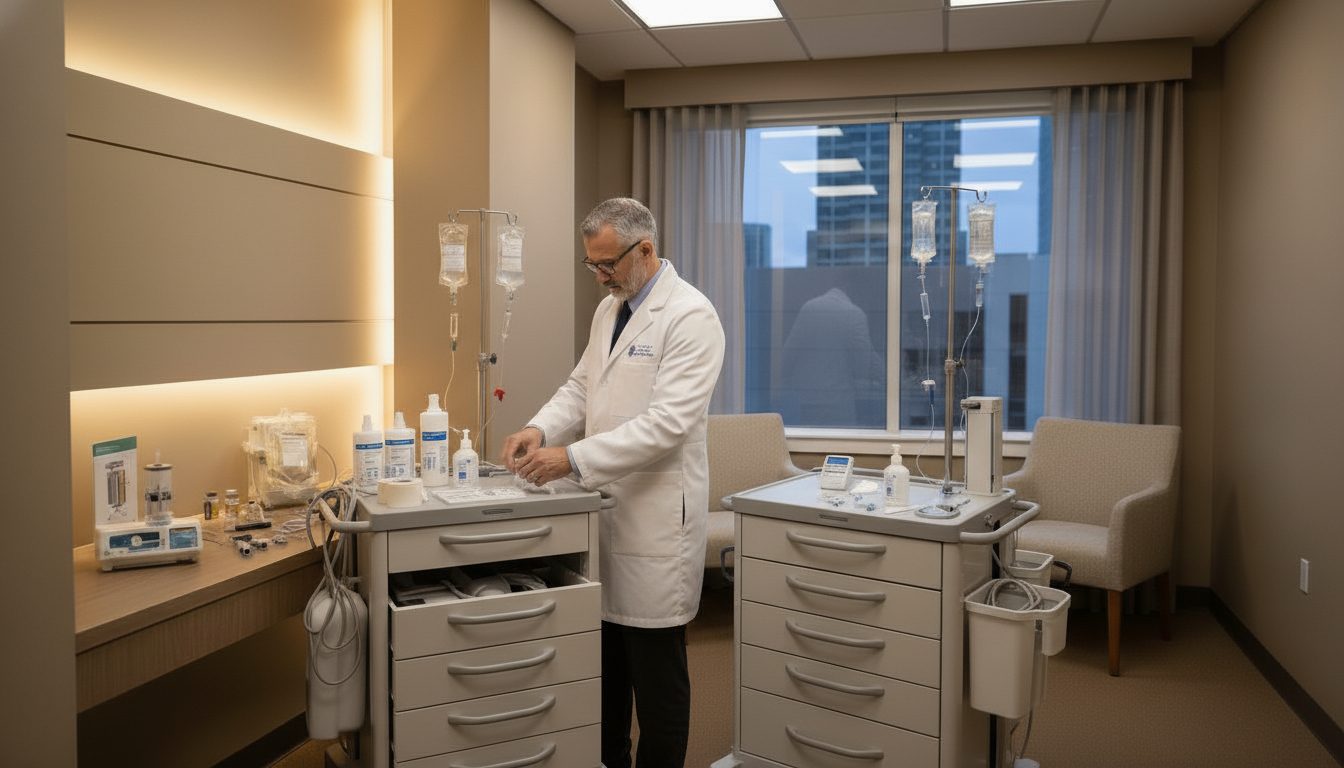
Most clinicians planning a ketamine practice start by pricing equipment, and are relieved by what they find. An infusion chair, a cardiac monitor, an infusion pump, an IV pole, a crash cart, an AED and oxygen come to roughly $16,000 for an office and one treatment room. The consumables for a single infusion, including the ketamine itself, the IV set, the solution and the dressings, come to under $20.
So if a practice charges a few hundred dollars a session and each session costs twenty, why do so many of these clinics close?
The thing nobody budgets for
What actually closes ketamine practices is working capital.
A practice does not fail because the pump was too expensive. It fails because the owner ran out of money before patient volume caught up.
Consider a practice with $36,000 a month in fixed costs, charging $500 a session with about $100 of variable cost per patient. It breaks even at roughly 60 infusions a month, which is three a day, five days a week. Reaching that volume takes between six and twenty-four months depending on the market and how much is spent on reaching patients.
The capital you need is not the cost of opening. It is your monthly fixed cost multiplied by the months to break even, plus about three months of buffer. On the example above, a practice that takes fifteen months to fill needs working capital in the hundreds of thousands, not the tens.
Many physicians budget $50,000 to $100,000, which covers two or three months. That is the single most common reason a clinically sound practice shuts down inside two years.
How long an undercapitalized practice typically survives, regardless of how good the medicine is.
A practice does not fail because the pump was too expensive. It fails because the owner ran out of money before the chairs filled.
Gerald W. Grass, MDThe work itself
Eight things you have to get through.
None of them is difficult on its own. The difficulty is that they are sequential, several have waiting periods, and getting one wrong can stall the rest.
Entity and legal framework
Formation, licensure in the entity’s name, tax registration. Typically four to eight weeks, so begin about twelve weeks before you intend to open.
Premises
800 to 1,200 square feet for a small practice: reception, two or three treatment rooms at 100 to 120 square feet each, a recovery area, consultation room, medication prep, storage. A treatment room should be no smaller than 10 by 12 feet. Have an attorney read the lease.
Equipment
Monitoring to sedation standards, infusion pump, emergency equipment and oxygen. The list is short and the cost is modest. Choosing correctly matters more than spending more.
DEA and controlled substances
Ketamine is Schedule III. Registration runs $888 every three years, plus a state controlled substance licence where required. You need a safe meeting DEA specification, a logbook covering every acquisition, administration and disposal, limited access, and periodic reconciliation.
Your state board’s rules
Office-based sedation rules vary by state, and several states are now writing rules specific to ketamine clinics. This is the step most often skipped and the one most likely to cost you later.
Staffing
Personnel is 45 to 55 percent of operating cost, and it is the number that decides whether your fixed costs are survivable. Decide early who is in the room during an infusion and who is not.
Protocols and documentation
Written treatment protocols, emergency procedures, informed consent, monitoring standards, discharge criteria and outcome tracking. Boards increasingly ask to see these, and so does any malpractice carrier.
Patients
Clinical quality is invisible until someone is referred to you. Most durable practices are built on relationships with local psychiatric and primary care providers rather than on advertising.
Two ways in
You do not have to open a clinic to offer this.
From scratch
A dedicated center carries the full fixed cost from day one: lease, staff, equipment, and a marketing budget large enough to fill the chairs before the money runs out. It makes sense in a market with enough patient density to support it.
Inside the practice you already have
A psychiatrist, pain physician or nurse practitioner with an existing panel can add infusions to rooms and staff that already exist. The capital requirement is a fraction of the above, the patients are already yours, and the risk if it grows slowly is much smaller.
For most clinicians who ask us how to start, the second route is the one that works. It is also the one almost nobody writes about.
The detailed version of this route
Our training site carries the full implementation guide for adding infusions to a practice you already run: whether your practice fits, the five things to check in your own building, the three ways to schedule a two-hour appointment, what equipment you may already own, the controlled substance requirements, and what the first year of patient volume actually does.
Adding ketamine to the practice you already have →What is coming
Several states are writing rules specifically for ketamine clinics.
Utah, Alabama and Texas have moved first, and what they are drafting points the same way: documented advanced training in ketamine therapy, written treatment and emergency protocols, continuous monitoring throughout treatment, thorough informed consent, and tracked outcomes.
A practice built to that standard now will not need retrofitting. A practice built to the minimum will.
What our graduates get
The parts that take longest are the ones we hand over.
Clinicians who train with us take home a business planning manual covering practice structure, space planning, staffing, equipment and vendors, a state compliance worksheet, the clinical protocols adapted to their own site, and the Clinical Companion app. The equipment list carries the actual models, suppliers and current prices, so the sourcing is already done.
Most graduates run their first infusion in their own practice within six weeks of the course, and the mentorship year that follows includes a review of the first infusion plan before it is used.
Going further
If you want the detail rather than the overview.
This page is the shape of the decision. The implementation guide on our training site is the practical version: room specifications, an equipment checklist with costs, DEA storage requirements, staffing competencies, scheduling models with a sample week, and realistic first-year volume.
The training that sits behind all of this.
Four days in a working infusion center in Sarasota, four clinicians to a session, then twelve months of mentorship while you open.
This page describes general requirements and typical costs and is not legal, tax or financial advice. Requirements vary by state and change. Have your own attorney and accountant review your plans, and confirm current rules with your state medical board and the DEA. Ketamine is FDA-approved as an anesthetic; its use for depression and chronic pain is off-label.