
Fibromyalgia
Ketamine infusion therapy for fibromyalgia
The published evidence for ketamine in fibromyalgia is thin, and we are not going to dress it up. This page sets out what the trials found, where an infusion course reasonably fits, and what we see in our own practice.
What you are dealing with
Pain the usual tests do not explain
Widespread pain, sleep that does not restore you, fatigue that rest does not fix, and trouble holding on to words, names and threads of thought. The scans come back normal. The blood work comes back normal. Part of what makes fibromyalgia exhausting to live with is that the problem is entirely real and does not show up where people look for it.
Current understanding places the problem in how the central nervous system processes pain signals rather than in damage to the tissue that hurts. Pain medicine has a name for this pattern — nociplastic pain — and fibromyalgia is its clearest example. That is why treatments aimed at the painful area often disappoint, and it is the reason a drug that acts centrally is worth asking about at all.

Every course begins with a consultation and a review of your records.
Where this belongs
What comes first, and why we say so on this page
The European guideline group reviewed the whole field of fibromyalgia treatment and issued exactly one strong recommendation: exercise. Every medication reviewed, without exception, received a weak recommendation, with effects the group described as relatively modest.1
We put that on a page about infusions because it is true, and because it tells you where an infusion belongs. Not first. An infusion course is something to consider when a graded exercise program and the licensed medications have been tried properly and you are still not living the life you want to live.
The published evidence
What the trials found
The studies are few and small. Two systematic reviews between them cover around a hundred and twenty patients in total, most of them in trials of a dozen to thirty people.5,6
The low-dose infusions used in those trials, roughly 0.3 to 0.5 mg/kg given over ten to thirty minutes, did reduce pain, and in some studies reduced tenderness and the spread of referred pain as well.3,4 The relief was usually measured in hours. The one randomized trial that followed patients out to eight weeks reported its finding in its title: absence of long-term analgesic effect.2
Looking across the published doses, it observed an apparent dose-response, and the longest-lasting results came from higher-dose repeated protocols rather than from the single low-dose infusions.5 But those longer results came from reports of one and two patients, not from controlled trials. It is a reason to ask the question. It is not evidence that the question has been answered.
How we use it
A trial of treatment, with a stopping point
We treat fibromyalgia after other things have been worked through, not instead of them. If you have done the exercise program, tried the licensed medications properly, and worked through what your physician has offered, and the pain and the fog are still running your days, then a course of infusions is a reasonable thing to try.
We plan it as a trial of treatment rather than an open-ended commitment. You will know early whether it is doing anything for you, and if it is not, we will say so rather than book you for more.
We also ask that you keep going with the exercise program. It is the one intervention with strong evidence behind it, and nothing we do replaces it.
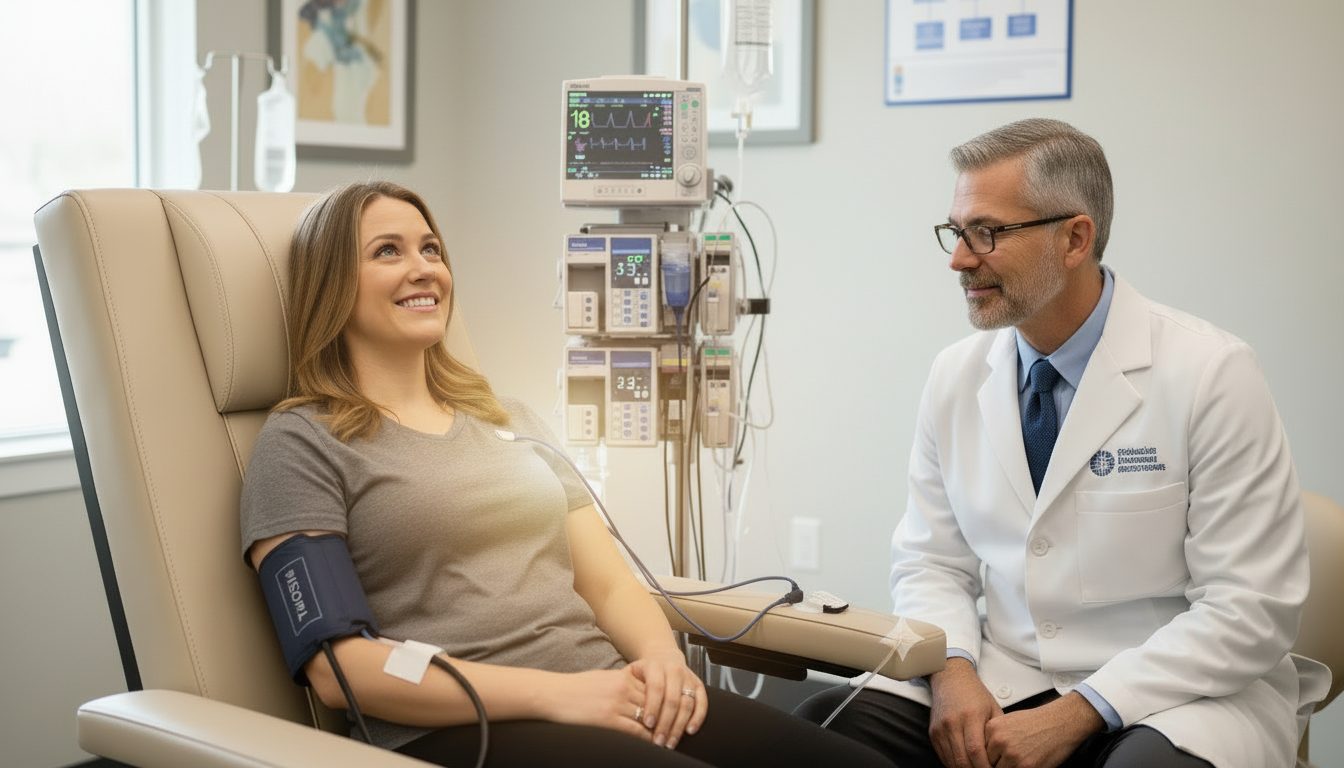
A defined course, with a defined point at which we stop and reassess.
Our own experience
What we have seen here
The patients we have treated for fibromyalgia have often done well, and not only with pain. What we hear about most is mental clarity: the fog lifting, concentration returning, being able to follow a conversation or finish a task without losing the thread.
We use a higher total exposure than the brief low-dose infusions used in the published trials, and we think that difference matters. The trials were not designed to test what we do.
It has no control group, it has not been collected or analyzed as research, and it has not been peer reviewed. It is not a rate, and it is not a prediction of what will happen for you. We include it because we think you should have both: what the literature reports, and what we see.
The course
How a RESTORE course is given
Whether a further course is needed, and when, is decided by your score on a validated rating scale rather than by a fixed monthly cycle. Side effects during the infusion are common and short-lived: a dissociative or dreamlike feeling, dizziness, changes in hearing or vision, sometimes nausea. They settle as the infusion is tapered and the medication clears. The safety page sets out the risks and the limits in full.
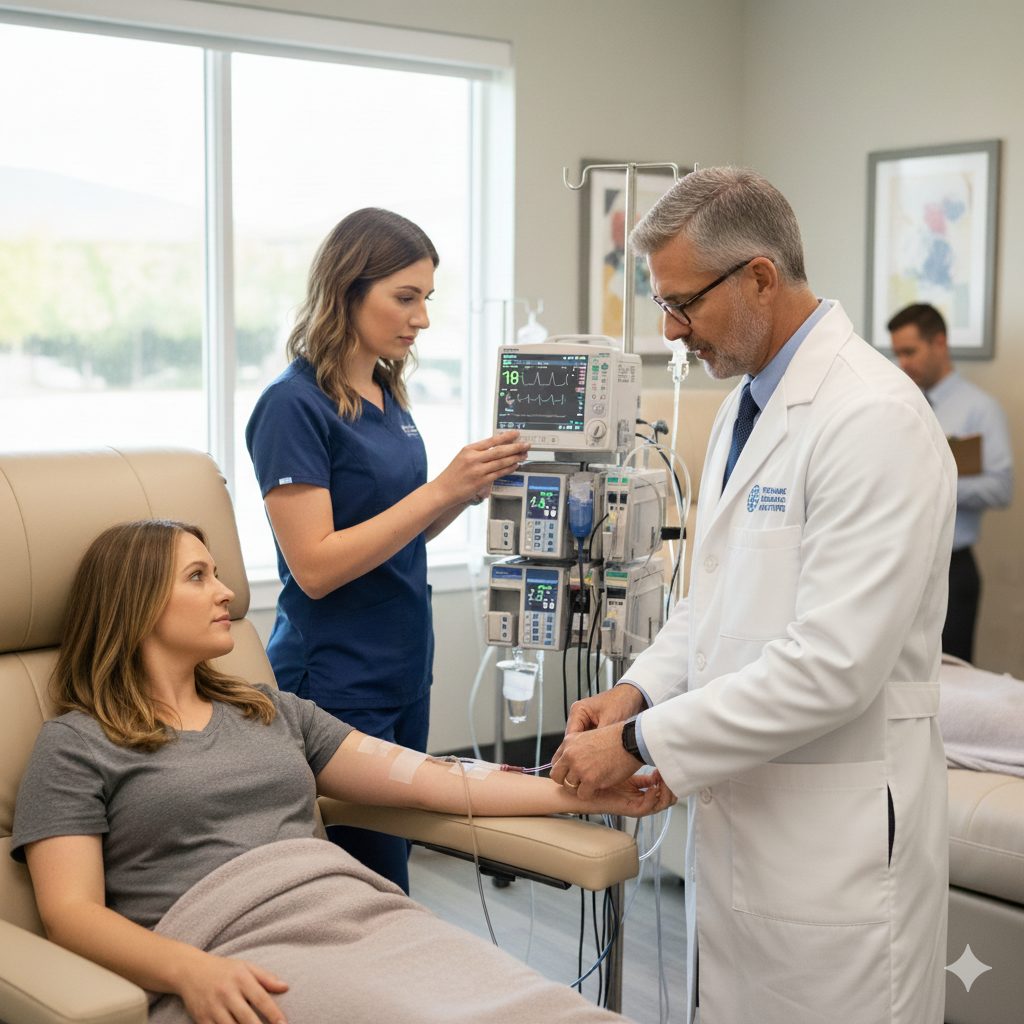
Monitoring runs throughout, and the record from each day shapes the next.
Whether to ask
Whether this is worth a conversation
It may be worth asking about if you carry a diagnosis of fibromyalgia, you have worked through exercise and the licensed medications without getting your life back, and you are prepared to treat this as a trial with a defined stopping point rather than a cure.
It is less likely to be the right move if you have not yet had a proper run at the things with better evidence behind them. We would rather tell you that than take your money.
It does not help everyone, and we cannot tell in advance who it will not help. If it is not working for you, we will say so early rather than sell you a further course.
References
1. Macfarlane GJ, Kronisch C, Dean LE, et al. EULAR revised recommendations for the management of fibromyalgia. Ann Rheum Dis. 2017;76(2):318–328.
2. Noppers I, Niesters M, Swartjes M, et al. Absence of long-term analgesic effect from a short-term S-ketamine infusion on fibromyalgia pain: a randomized, prospective, double-blind, active placebo-controlled trial. Eur J Pain. 2011;15:942–949.
3. Graven-Nielsen T, Aspegren Kendall S, Henriksson KG, et al. Ketamine reduces muscle pain, temporal summation, and referred pain in fibromyalgia patients. Pain. 2000;85:483–491.
4. Sörensen J, Bengtsson A, Ahlner J, et al. Fibromyalgia — are there different mechanisms in the processing of pain? A double-blind crossover comparison of analgesic drugs. J Rheumatol. 1997;24:1615–1621.
5. Pastrak M, Abd-Elsayed A, Ma F, Vrooman B, Visnjevac O. Systematic review of the use of intravenous ketamine for fibromyalgia. Ochsner J. 2021;21(4):387–394. PMID 34984054.
6. Carvalho JF, de Sena EP. Ketamine in fibromyalgia: a systematic review. Adv Rheumatol. 2024;64:54. PMID 39075628.
Related pages
The RESTORE Method Are You a Candidate? Safety, Risks and Limits Our Results Fees
Talk to us
Not sure whether this is worth a conversation?
We will go through what you have already tried and tell you honestly whether a course of infusions is likely to be any use to you.
RESTORE — ketamine therapy, done precisely.