
Our medical director
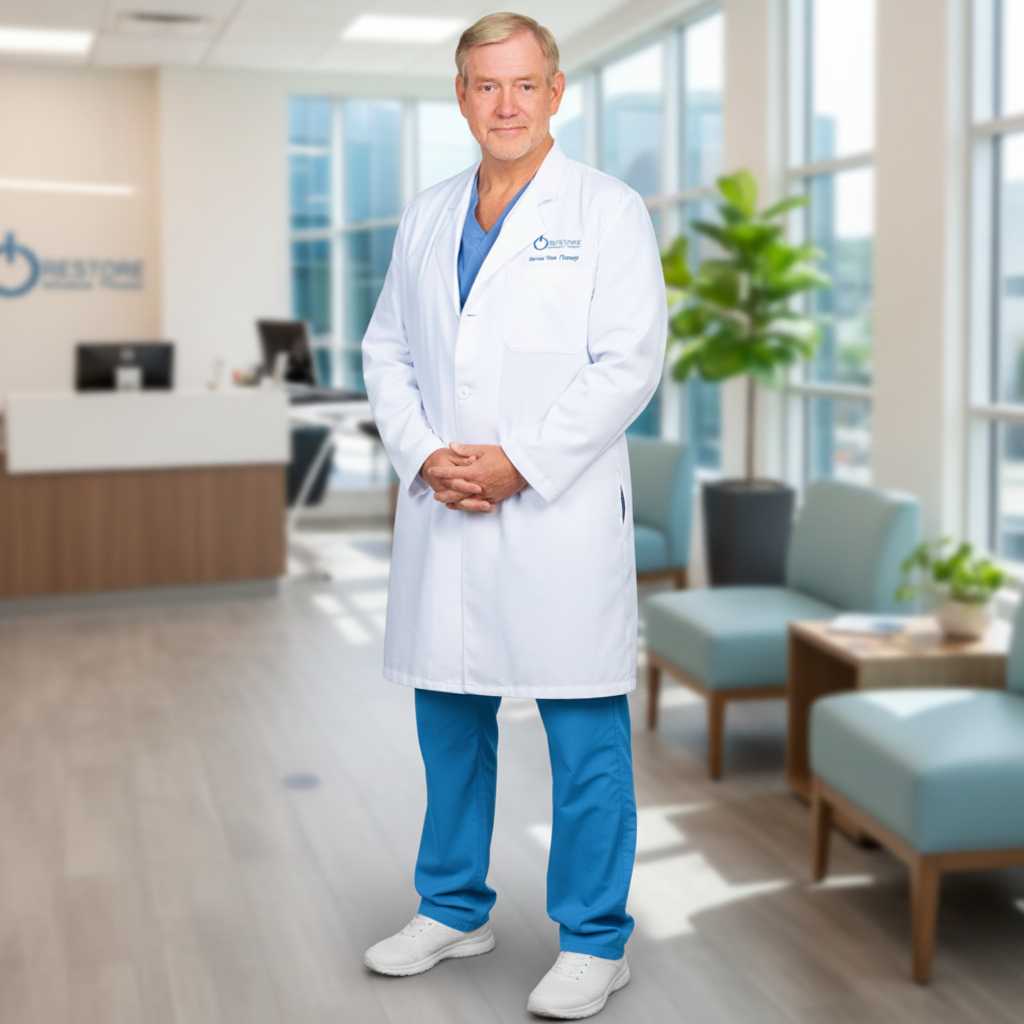
Gerald W. Grass, MD
The physician who developed the RESTORE Infusion is the physician who gives it.
In medicine since 1983. Working with ketamine since 1985. Founder and Medical Director of the Ketamine Research Institute in Sarasota, Florida.

Where the work on ketamine for depression began
The first randomized, placebo-controlled trial of ketamine in treatment-resistant major depression was published in 2000 by a group in the Yale Department of Psychiatry.1 It was a small crossover study in seven patients, and it is the paper that everything since has been built on.
Dr. Grass taught and practiced at Yale. As Assistant Professor of Anesthesiology and Pain Medicine, and Director of the Yale Pain Medicine Fellowship Program, he worked with members of that department on the clinical use of ketamine in mood and addiction disorders.
The dose those early studies used, 0.5 mg/kg infused over forty minutes, was chosen to test whether an antidepressant effect existed at all. It was a research dose. The papers do not present it as a finished treatment plan, and it was never meant to be one.
That is the starting point the RESTORE Infusion was built from. It is not a different drug and it is not a different formulation of ketamine. It is a different way of deciding the dose, a different way of delivering it, and a considerably longer look at the patient beforehand.
1. Berman RM, Cappiello A, Anand A, et al. Antidepressant effects of ketamine in depressed patients. Biol Psychiatry. 2000;47(4):351–354. PMID 10686270.
Who is in the room
Dr. Grass has given thousands of ketamine infusions.
He starts your IV. He runs your infusion. He sits beside you until it ends and until you are through the early part of recovery. The same physician, from the first minute to the last.
He sees every new patient himself, and every change — to a dose, a rate or a plan — is his. Those changes get made while the infusion is running, because that is when they are worth anything. An adjustment made afterward applies to your next infusion, not to this one.
Giving and monitoring an anesthetic agent outside an operating room is a specific skill. It is the one he trained in.
The training behind the protocol
Dr. Grass trained across four fields. Each one shows up somewhere in how the infusion is given, which is why the range matters to you and not only on a curriculum vitae.
Dosing to a measured target concentration in the blood rather than to body weight. The airway assessment and the sedation monitoring that make it appropriate to give an anesthetic agent outside an operating room at all.
The concentration targets used for nerve pain. The work of classifying a pain condition before recommending ketamine for it — and of saying plainly when ketamine is not the right treatment.
Where he first used ketamine, in 1985. Reading spinal imaging and examining a nervous system, which is most of what the assessment before a pain infusion consists of.
Sixteen years of it, four as a department chief, at hospitals including two Level I trauma centers. Ketamine in routine use throughout — and where airway management and resuscitation stop being knowledge and become reflex.
And one more thing, which sits alongside rather than underneath
Over the same years he trained in medical acupuncture, neuromodulation techniques, medical hypnosis and biofeedback, at UCLA, in Toronto, in Vancouver and in Japan.
None of that is what RESTORE is built on. The infusion is built on measured plasma concentrations and pharmacokinetic modeling, and nothing displaces that. What those years taught him was how much of what a patient gets out of a treatment depends on the state they are in when they receive it, and that the state can be prepared deliberately rather than left to chance. It is why the preparation before your infusion, and the room you receive it in, are treated as part of the treatment rather than as decoration.
He was teaching ketamine before there was a course to teach it in
From around 2004 he lectured on ketamine inside the residency and fellowship programs he worked in and then directed — in New York, at Stony Brook, and at Yale, where he ran the Pain Medicine Fellowship Program and the Department of Anesthesiology’s chronic pain rotation. The audience then was residents, fellows and attending physicians.
Between 2007 and 2013 he directed Region 1 of the VA SCAN-ECHO project, a hub-and-spoke physician education and specialty consultation network he established with a $4.5 million grant. It reached eleven states, 33 medical centers, 157 community-based outpatient clinics, roughly 760 primary care providers and about a million patients.
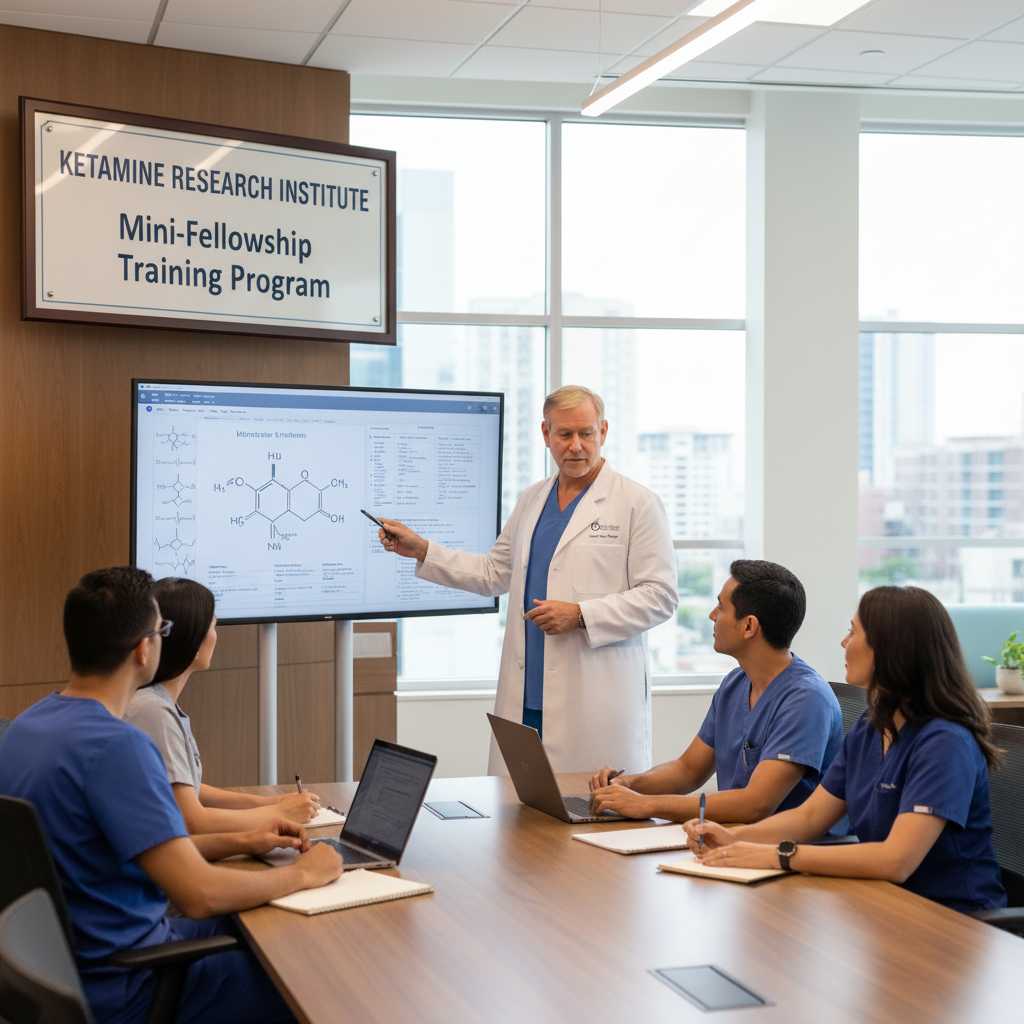
The course for clinicians in private practice came out of all of that, and began in 2016. It runs quarterly: six modules and forty-six sections, combining classroom instruction with supervised clinical training in a working infusion suite.
Two bodies of that work are registered with the United States Copyright Office: Ketamine Infusion Center Standards — Guidelines for Ketamine Infusion Therapy in Non-Hospital Facilities (TXu002183277, December 2019), and the clinician course itself (TXu002192721, December 2019).
Why that should matter to a patient: the way this practice runs is written down, dated, and on file with a federal registry. Other physicians are taught from it and are expected to follow it. It is a standard, not a set of habits, and you can check that it exists.
The path to RESTORE
- 1983 — Doctor of Medicine with Honors, State University of New York at Buffalo. Alpha Omega Alpha.
- 1983–1984 — General surgery internship, Millard Fillmore Hospital, Buffalo.
- 1984–1986 — Neurological surgery residency, SUNY Buffalo affiliated hospitals. He first used ketamine in 1985, in his second year.
- 1986–2002 — Emergency medicine across Western New York, including four years as Chief of Emergency Medicine at Medina Memorial Hospital and attending work at two Level I trauma centers.
- 2002–2005 — Anesthesiology residency, Mount Sinai/NYU Medical Center, New York, with a six-month clinical specialist track in pain medicine.
- 2005–2006 — Interventional pain medicine fellowship, State University of New York at Stony Brook.
- 2006–2007 — His first infusion-based pain practice, in Newport News, Virginia, using NMDA and AMPA receptor agents alongside conventional management.
- 2007–2013 — Yale University School of Medicine and VA Connecticut. Treating veterans returning from Iraq and Afghanistan with chronic pain, depression and post-traumatic stress. This is where RESTORE began.
- 2015 — Founded the Ketamine Research Institute in Sarasota.
Appointments and national roles
- Yale University School of Medicine, Department of Anesthesiology, 2007–2013. Assistant Professor of Anesthesiology and Pain Medicine. Director, Yale Pain Medicine Fellowship Program. Director, Department of Anesthesiology chronic pain rotation.
- VA Connecticut Healthcare System, 2007–2013. Chief of Pain Medicine, serving all six New England states. Director, Neuropathic Pain and Related Disorders Program. Director, Region 1 VA SCAN-ECHO.
- US Department of Veterans Affairs, VISN 8 and 16, Florida and Alabama, 2015–2016. Chief of Pain Medicine.
- Mount Sinai/NYU Medical Center, New York, 2002–2005. Department of Anesthesiology.
- State University of New York at Stony Brook, 2005–2006. Interventional pain medicine.
- State University of New York at Buffalo, 1983–1986. Neurological surgery and general surgery.
National service
- VA and Department of Defense interagency task force for integrated pain medicine.
- National pain management core curriculum development for the Veterans Health Administration.
- Chairman, VISN 1 pain management subcommittee, and member of the national pain medicine committee at VA Central Office.
- Peer reviewer, Pain Medicine (2009) and the Journal of Rehabilitation Research and Development (2008).
Research and clinical trials
Principal investigator
- 2010–2013 — VA Connecticut pilot study: the use of NMDA antagonists, including ketamine, with an enhanced multimodal infusion technique, in intractable neuropathic pain syndromes. This is the work the RESTORE Infusion grew out of.
- 2010–2013 — VA Connecticut pilot study: transcranial magnetic stimulation in the treatment of chronic pain states.
- 2017–2018 — Four multicenter, randomized, double-blind clinical trials of a neuroactive steroid in postpartum depression, one of them in adolescent patients.
Industry roles
- 2016–2018 — Medical director for Phase III psychiatric and neurological drug development, providing medical oversight to biotechnology and pharmaceutical companies in trials covering Alzheimer’s disease and other neurodegenerative disorders, ADHD, unipolar and bipolar depression, anxiety, PTSD and schizophrenia, in adult and pediatric populations.
- 2018 — US clinical advisor and medical director to a biotechnology company working in ketamine infusion therapy for mood disorders.
Program funding secured
- $4.5 million to establish the VA Specialty Care Access Network in the Northeast, the program behind the SCAN-ECHO figures above.
- $750,000 in special opportunity funding to build pain medicine resources for veterans returning from Iraq and Afghanistan across five facilities.
- $360,000 from the Veterans Health Administration Office of Academic Affairs, to serve as the sole clinical site for the Yale Department of Anesthesiology chronic pain rotation.
Research programs at VA Connecticut
- Implementation of a stepped-care model of pain treatment. Donaghue Foundation Program for Research Leadership Grant, 2009–2013. R.D. Kerns, Principal Investigator.
- Cognitive behavior therapy for diabetic peripheral neuropathic pain. VA Rehabilitation Research and Development Merit Grant B6044R, 2008–2010. R.D. Kerns, Principal Investigator.
Publications
Dr. Grass has published and lectured on pain medicine and on ketamine infusion therapy. Selected work follows.
Book chapters
- Grass GW. Management of neuropathic pain. In: Vadivelu N, Hines R, Urman R, eds. Essentials of Pain Management. Springer, 2011.
- Grass GW. Management of spinal disease. In: Ebert M, Kerns R, eds. Behavioral and Psychopharmacologic Pain Management. Cambridge University Press, 2011.
- Grass GW. Neuropathic pain. In: Vadivelu N, Jahr J, eds. Pocket Pain Medicine. Lippincott Williams & Wilkins, 2011.
Peer-reviewed articles
- Rozen D, Grass GW. Interventional pain medicine approaches to nonradicular low back pain of internal disc degeneration origin. Pain Physician. 2005;8:357–363.
- Rozen D, Grass GW. Intradiscal electrothermal coagulation and percutaneous neuromodulation therapy in the treatment of discogenic low back pain. Pain Practice. 2005;5(3):228–243.
- Rozen D, Grass GW. Perioperative and intraoperative pain and anesthetic care of the chronic pain and cancer pain patient receiving chronic opioid therapy. Pain Practice. 2005;5(1):18–32.
- Kramer D, Grass GW. Challenges facing the anesthesiologist in the emergency department. Current Opinion in Anaesthesiology. 2003;16:409–416.
- Grass GW. Reversal of chemotherapy-induced myelosuppression with electroacupuncture. Medical Acupuncture. 2003;15(3).
- Grass GW. Percutaneous electrical nerve stimulation in the treatment of irritable bowel syndrome: a case report. Medical Acupuncture. 2002;13(2).
Selected presentations and lectures
- 2022 — A new methodological approach to improve the real-world effectiveness of ketamine infusion therapy for treatment-resistant depression. Psych Congress 2022, New Orleans, LA, September; and the 6th International Conference on Neurology and Brain Disorders, Orlando, FL, October.
- 2019 to present — Ketamine infusion center standards: guidelines for ketamine infusion therapy in non-hospital facilities. Presented quarterly in the Institute’s clinician training program.
- 2016 to present — Ketamine infusion therapy for mood disorders: an intensive training course for clinicians. Presented quarterly at the Ketamine Research Institute.
- 2016 — Ultra-rapid outpatient opioid detoxification using a novel enhanced multimodal ketamine infusion. International Conference on Opioids, Boston, MA.
- 2016 — Sequential ketamine infusions using an enhanced multimodal infusion technique for rescue from intractable pain and withdrawal symptoms associated with intrathecal pump misadventure. Presented at two national pain medicine and regional anesthesia meetings, Palm Springs, CA.
- 2015 — Ketamine intravenous therapy for the treatment of chronic pain. Pain Management Grand Rounds, Walter Reed Medical Center, Department of Defense.
- 2015 — Ketamine: a molecular reset button for chronic pain and depression. VA SCAN-ECHO telemedicine presentation to primary care providers, VISN 5 through VISN 8.
- 2012 — A series of VA SCAN-ECHO telemedicine lectures to primary care providers across VISN 1 through VISN 4, including complex regional pain syndrome, medicolegal aspects of pain medicine, interventional options, radiological anatomy and chronic spinal pain.
- 2012 — The VA SCAN-ECHO initiative. Presented at national and international meetings on pain medicine and telemedicine, including in Luxembourg and Whistler, British Columbia.
- 2009 — Chronic opioid therapy for non-malignant pain: confusion, controversy and consensus. Yale and VA Connecticut Department of Psychiatry Grand Rounds.
- 2009 — Instructor, Yale University regional anesthesia cadaver laboratory, Yale University School of Medicine.
What he is working on now
These are open questions, not treatments on offer. Nothing here is being sold to you, and nothing here is a claim that any of it works.
- Optimizing the serum concentration and the total exposure over the course of an infusion, for mood disorders and for chronic neuropathic pain.
- How hormonal and metabolic variables affect whether a given person responds to ketamine at all.
- Positive modulation of allosteric and metabotropic receptors, and whether it can improve what an intravenous infusion achieves.
- Alpha and theta entrainment during an infusion, and whether visual and auditory stimulation change what a patient takes away from the experience.
- The effects of intravenous ketamine in neurodegenerative disorders.
Research that stops once a protocol works is how a protocol stops improving. The reason to tell you about it is that it is the same physician doing both, and these are the questions he is actually chasing.
Talk to us
Speak with the physician who would treat you
Tell us what you have already tried and we will tell you honestly whether this is likely to help.
RESTORE — ketamine therapy, done precisely.